
Unconstitutionalities: the Security and Vandalism Laws

Dossier Surveillance in Angola
Newspaper article
Rui Verde
Disliking a law is not the same as declaring it unconstitutional. In fact, democracy exists to decide on disagreements and is defined by majority decision, respecting the Constitution.
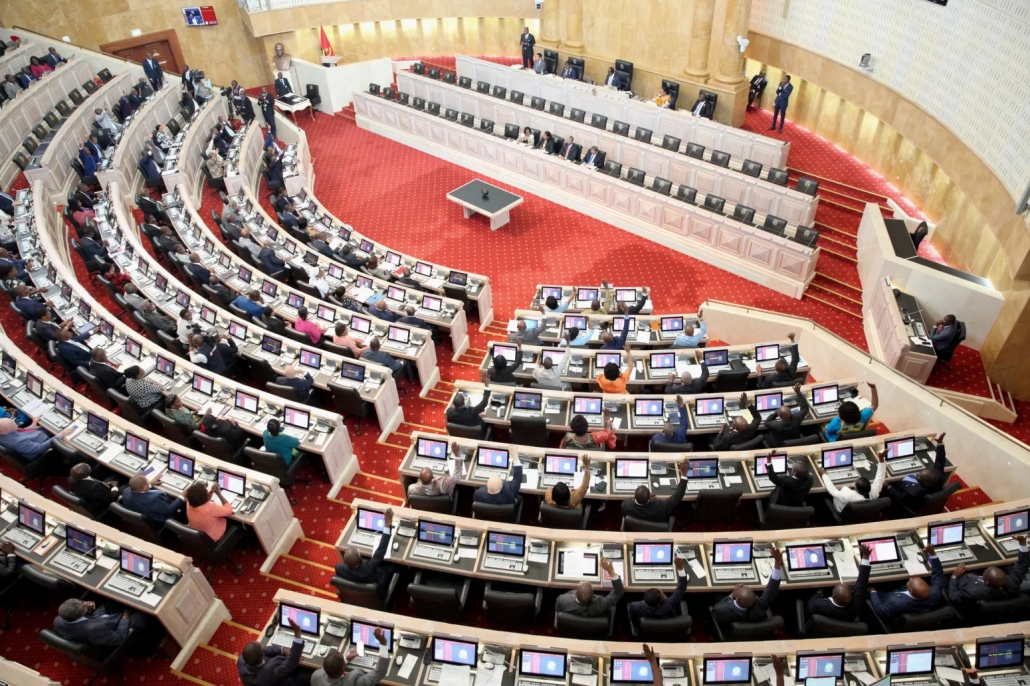
This question arises in relation to two recent laws passed by the National Assembly: the National Security Law (Law No. 15/24 of 10 September) and the Law against Vandalism of Public Property (Law No. 13/24 of 29 August).
The discussion of these laws has sparked heated debates and disputes, with only one extreme position on each side of the argument: either the laws were totally unconstitutional and should be eradicated outright, or they were perfect and there was nothing to change.
The reality, however, is different. Both laws raise questions about certain unconstitutionalities that need to be removed or clarified, but contrary to what has been described, they are not draconian monstrosities. Perhaps for this reason, UNITA, the main opposition party, abstained in the final vote on both laws, not voting against them.
In this sense, it is important to distinguish between a maximalist approach and a minimalist view of unconstitutionality.
Unconstitutionality is not a political or a matter of taste, it is a technical issue and, in simple terms, it translates into the non-compliance of a legal norm with a constitutional norm.
The Constitution is the supreme norm and, as such, is necessarily general, based mainly on principles and sparse indications of the main rules that should prevail in a country. This means that, by its very nature, the Constitution does not provide a direct answer to all legal questions, and the interpretative effort is both greater and more careful than in the interpretation of a law. The foundations of the State, the freedom of citizens and the functioning of institutions are always at stake.
That is why a minimalist and technical approach to questions of unconstitutionality is advocated, freeing them as much as possible from political baggage.
The best contribution that can be made to the fair enforcement of the National Security Law and the Law Against Vandalism of Public Property is to point out specifically and concretely their possible unconstitutionalities, so that the Constitutional Court can effectively rule on them, rather than issuing generalised anathemas that mix everything up and solve nothing.
As the poet Camões beautifully wrote in a sonnet, ‘I embrace the whole world and hold nothing’. Those who opt for a maximalist view of unconstitutionalities are like the lyrical self in Camões’ sonnet: they embrace everything and hold nothing.
Thus, in summary, in order to be specific and not just use general words, the main unconstitutionalities that can be seen in the aforementioned laws are listed below.
With regard to the National Security Law – in the version of the proposed law and not the final version – it was understood that Article 40 (Special duty of cooperation) would be unconstitutional, as it established a general duty to report threats to national security, which were not clearly specified and only vaguely stated. In turn, Articles 39 (Duty to cooperate) and 36 (Preventive measures) did not appear to be unconstitutional (although the issue is debatable), since, based on their wording, they did not appear to be prescriptive rules, i.e., they did not impose a legal command. Article 39 created a civic and patriotic duty to cooperate in the pursuit of national security objectives, rather than a legal duty, let alone a sanctioned one. Article 36 – the one that caused the most uproar, as it appeared to grant broad powers to the security forces – did not, in fact, grant new or different powers to the security forces, but merely listed those already provided for in other laws and in the Constitution.
All of this was explained in an article on this website last February.
The truth is that, once the final version of the law was published (Series I, No. 174, 10 September 2024), it became clear that the detailed discussion in the National Assembly had been fruitful, and the enacted law no longer contained the main problems that had been noted.
Thus, the article that caused the most controversy – the famous Article 36 on preventive measures – no longer exists. Similarly, the former Article 40 on the special duty of collaboration, which we called the “generalised snitching” article, has been transformed into Article 37, with a defined scope based on express law, dispelling the spectre of an absurd duty to report.
However, Article 39, which was dedicated to the duty of patriotic and civic cooperation with the intelligence services, has been retained, now as Article 36. It is understood that this article does not create any legal obligation and that failure to comply with it does not entail any penalty. In any case, a constitutional assessment of the issue would be enlightening.
The novelty lies in Article 35, which reworded what was previously Article 38, which established a duty for citizens to participate in the national security system, specifying what that participation would entail: ‘[n]ot fulfilling their duty to serve in National Defence, Public Security and Internal Order’. The current Article 35 is short, stating that ‘national citizens have a duty to participate in the achievement of National Security objectives, in accordance with the Constitution and the Law.’ It has become an overly vague and generic rule, which may allow the enforcer a margin of latitude that is not well defined.
In conclusion, the final form of the National Security Law does not present the dangers anticipated in its initial version, prior to public and legislative discussion, demonstrating that civic and public discussion of the issues is fundamental. It has been modified for the better. However, in terms of legal certainty, it would be beneficial to see a clear interpretation of Articles 35 and 36.
As for the Vandalism Law, there are two articles that are cause for concern: Article 7 (Destruction of public road, rail and water transport infrastructure or means of transport) and Article 9 (Promotion of vandalism of public property and services).
These articles have two problems. Firstly, they provide for the maximum penalty of 25 years, which is disproportionate. The principle of proportionality, enshrined in Article 2 of the Constitution, establishes a balance between crime and punishment in order to ensure criminal justice. It makes no sense for the destruction of public property to be equated with genocide or aggravated murder.
Secondly, they propose a vague nature of the criminal offence, which violates the principle of criminal legality (Article 65 of the CRA). The principle of criminal legality includes what is known as criminal typicality. Typicality prevents the legislator from using vague, uncertain or indefinable formulas in the description of legal types of crime. There is a constitutional requirement for the content of criminal law to be determinable, both so that citizens can clearly understand what behaviour is not permitted and to avoid arbitrariness in the application of the law.
In summary, and according to the minimalist perspective of unconstitutionality defended here, the Constitutional Court should be called upon to rule on Articles 35 and 36 of the National Security Law as a matter of establishing constitutional interpretation, and on Articles 7 and 9 of the Law against Vandalism of Public Property.
This article was originally published in MakaAngola on the 16 February 2024. The article forms part of an eight-country research project titled “Public Oversight of Digital Surveillance for Intelligence Purposes: A Comparative Case Study of Oversight Practices in Southern Africa,” supported by the British Academy Global Professorship Programme through the University of Glasgow.