É público que as autoridades angolanas emitiram um mandado de captura internacional relativo a Isabel dos Santos.
Não se discute o mérito do mandado, pois sem conhecer as acusações concretas será tudo especulação, mas atenta-se na oportunidade. E o que chama a atenção, em termos de oportunidade, é o espaço de tempo que decorreu entre a saída de Isabel dos Santos de Angola (Agosto de 2018) ou a publicação dos denominados Luanda Leaks (Janeiro de 2020) que a comprometeriam de forma inabalável e a emissão do mandado (Novembro de 2022). Isto é, entre dois e quatro anos para emitir um mandado.
Obviamente, que é tempo demais sem ouvir direta e pessoalmente Isabel dos Santos em processos criminais com a pública e notória envergadura destes.
Este hiato temporal faz questionar sobre o que falhou no sistema judiciário angolano. A resposta parece encontrar-se no modelo seguido em Angola na chamada “luta contra a corrupção”, ou, generalizando, no grande crime económico.
As autoridades angolanas optaram por remeter os casos de grande crime económico para os meios comuns, Procuradoria-Geral da República, Tribunais ordinários, etc. O problema é que questões de “captura do Estado”, ou “privatização da soberania” como as que aconteceram em Angola dificilmente seriam resolvidas pelos meios comuns que têm os seus tempos e as suas práticas burocratizadas, muitas vezes comprometidas com os próprios atores dos supostos crimes.
A luta contra o crime económico a este nível de “captura do Estado” tem exigido nos, vários países em que acontece, a criação de instrumentos especiais para ultrapassar os obstáculos estruturais acima referidos.
Pode-se começar pelos Estados Unidos, onde situações de grande gravidade com impacto político, como as investigações a Richard Nixon, Bill Clinton ou Donald Trump têm assentado na nomeação de um Procurador Independente ( independent counsel). Estes procuradores independentes têm poderes próprios e podem ultrapassar as estruturas federais normais.
Na África do Sul, onde surgiu com extrema relevância a expressão “captura do Estado”, a opção foi a criação de uma poderosa Comission of Inquiry into Allegations of State Capture, mais conhecida como Comissão Zondo, nome do juiz que presidiu à Comissão. Esta Comissão levou a cabo um exaustivo e independente trabalho de investigação que originou vários relatórios que agora servem de base para acusações criminais. Também existiu na Ucrânia, antes da guerra, a criação de um sistema apoiado por várias entidades internacionais.
O ponto essencial deste muito breve excurso internacional é que situações de corrupção muito grave que colocam em causa a viabilidade ou sobrevivência do Estado impõem soluções de combate que saem da esfera do sistema judiciário normal, que porventura estará também assolado pelos mesmos problemas de corrupção e “captura de Estado”. Portanto, são normais as dificuldades que o combate ao crime económico encontra em Angola, sendo importante mudar a estrutura e a metodologia.
A mudança da estrutura e metodologia do combate à corrupção em Angola assenta na instituição duma Alta Autoridade contra a Corrupção com poderes judiciais próprios e independentes para investigar, acusar e levar a julgamento os grandes casos de corrupção num sistema judiciário e judicial único. A Alta Autoridade contra a corrupção poderia investigar, interrogar, apreender, fazer buscas e decretar medidas cautelares nos termos da Lei e depois teria uma Câmara para julgamentos ou remeteria diretamente a uma nova Câmara de crimes económicos junto do Tribunal Supremo. Operando no quadro constitucional e legal, esta Autoridade seria um organismo específico para reprimir a corrupção. Esta Alta Autoridade teria competência exclusiva para todos os casos principais de corrupção e faria os cruzamentos internacionais necessários.
As nações necessitam de estruturas específicas, focadas e flexíveis para combater a criminalidade económica mais evoluída como é a grande corrupção. Em Angola, urge uma estrutura desse tipo. É importante dar este passo na área da criminalidade económica.
https://www.cedesa.pt/wp-content/uploads/2022/11/isabel-santos.jpg10801920CEDESA-Editorhttps://www.cedesa.pt/wp-content/uploads/2020/01/logo-CEDESA-completo-W-curvas.svgCEDESA-Editor2022-11-23 17:35:432022-11-23 17:35:46Isabel dos Santos, crimes económicos e uma alta autoridade contra a corrupção
The recent Angolan elections on August 24, 2022 were the subject of intense scrutiny by Angolan and international public opinion. Interestingly a good part of the attention was devoted to political and/or legal subjects. There was a great deal of courts, electoral processes, law application, voting counting, multitude of initiatives and even constitutional revision.
However, the qualitative inquiries that a partner executed during the election period did not point out these as the main concerns of Angolans, but those linked to the economy, namely employment and unemployment. What Angolans seem to ask above all is a job and good living conditions.
Consequently, the issue of unemployment is one of the most important in the activity of the executive who has now taken office.
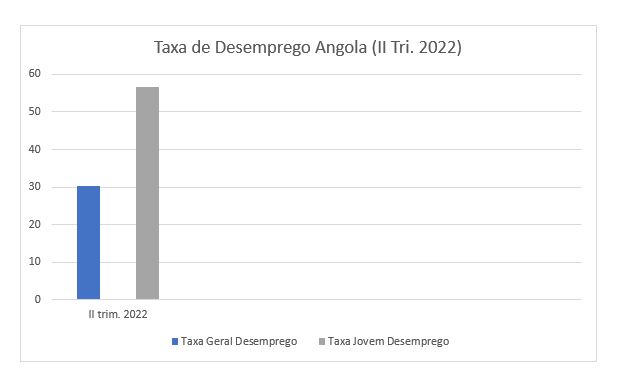
At this time, the most current data point to a 30.2% general unemployment rate (data from the National Institute of Statistics for the II Quarter of 2022) and the youth unemployment rate (15-24 years) will be located in the 56.7%[1]. The unemployed population over 15 years old in the entire country is calculated in 4 913 481 of people, while young people from 15-24 unemployed is 3 109 296.
Source: Instituto Nacional de Estatística de Angola
Even if they doubt statistics and considering the very large weight of the informal economy, which makes calculations difficult, the reality is that the unemployment rate is too high. By the way, it is almost certain that the high rate of youth unemployment has manifestly contributed to the MPLA defeat in Luanda.
Unemployment is one of Angola’s most serious and important political, economic and social problems.
Government Employment Policy
Government policy regarding unemployment has been essentially passive, although accompanied by some concrete programs.
Essentially, the government expects the effort of macroeconomic stabilization (budgetary equilibrium, public account control, exchange rate liberalization, etc.) to translate into an incentive to private investment that in turn will increase employment.
The inaugural address of the President reaffirmed this approach when he said that “we will continue to work on policies and good practices to encourage and promote the private sector of the economy, to increase the offer of national production goods and services, increase exports and create more and more jobs for Angolans, especially for younger people”[2] (our emphasis).
The Minister of State for economic coordination, now reappointed, had already pointed out this direction when referring to unemployment and public employment promotion programs, he does not mention them concretely, but focuses on macroeconomic aspects. In early September, Nunes Júnior advanced that he was confident in reducing unemployment based on the private sector, claiming that the government was able to “put the country in economic growth giving currency stability and net international reserves” and placed “the country on the economic balance track, exchange rate stability and international reserves”[3].
The government successes in the area of stabilization of public finances and currency politics are not challenged, what is doubtful is the belief that the Angolan private sector has immediate ability to resolve the issue of unemployment.
On the basis of this non-interventional policy on the correction of excessive unemployment is the neoclassical model that summarizes the essence of all economic activity to the free interaction between supply and demand for price flexibility. The neoclassical model has a valid relevance in many areas of economic analysis, but certainly will not be applicable linearly in the job market[4] and even less in Angola.
The government continues to believe that it is sufficient to create the appropriate framework conditions (financial and currency framing) and employment emerges moved by the private sector.
This would be so if Angola were a free market economy with a strong and capitalized private sector. Angola is nothing like that. It is an economy that began with a process of destruction and Sovietization after independence in 1975 and whose “liberalization” after 1992-2002, it was false, or rather, was post-soviet, imitating Mother-Russian: some oligarchs linked to power took advantage of privatization and alleged free markets to quickly “hand in hand” with political power take dominant positions. In fact, there have never been true entrepreneurs, but essentially political entrepreneurs. And there was never a private sector, but a sector of friends of power. This reality has no strength to promote employment as the minister wants.
Making the recovery of employment in Angola dependent and combating unemployment only in the private sector is impossible.
There are two orders of reasons why the policy against unemployment is only based on the private sector.
Firstly, the operation of the market. As a general rule, the labor market does not function as a free market, by obeying the rules of supply and demand defined by the neoclassical economic model that seems to sustain government philosophy, the behavior of the labor market is tendentially rigid, wages are hardly lowered or people are fired without social turmoil and constraints.
In technical terms it is said that the labor market operates as a market without compensation (non-clearing market)[5]. While according to neoclassical theory, most markets quickly reach a balance without excess supply or demand, this is not true for the job market: there may be a persistent level of unemployment. Comparison of the labor market with other markets also reveals persistent compensatory differentials between similar workers.
Keynes in the context of the 1930s crisis studied the subject and concluded that the economy could go into underemployment balances, this means that it can reach a level where it will never employ all potential workers and not leave without the intervention of a “visible hand” that would be the State[6].
The second reason is the magnitude of unemployment in Angola. It is one thing to expect that the private sector hire people when unemployment is 10% and it is intended to go down to 6%.
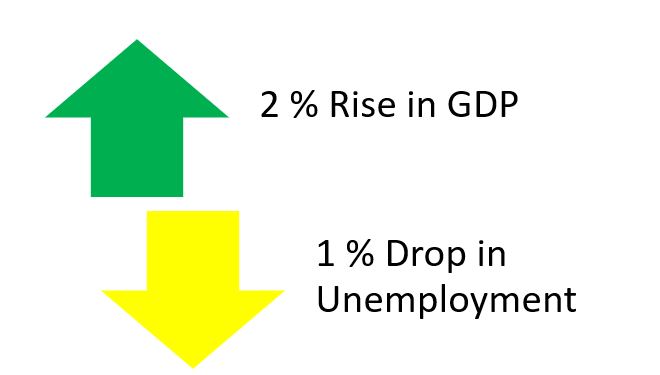
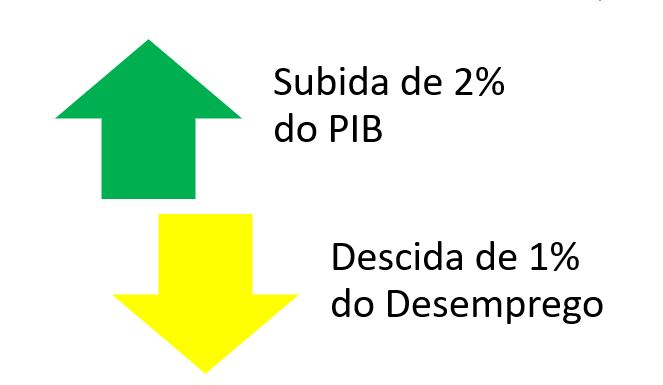
It is possible that economic growth automatically increases employment. Okun’s famous law[7], even though it is inaccurate, tells us that a 2% rise of the product (GDP) implies a decrease of 1% of unemployment. Thus, if Angola’s GDP increased 4% by 2023, unemployment would only drop 2%, i.e. to 28%. Manifestly insufficient.
Explanation of the Okun Law
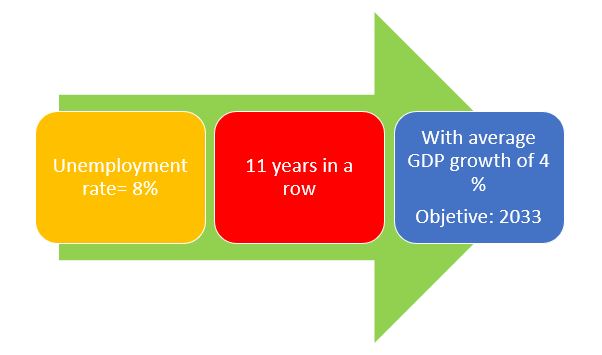
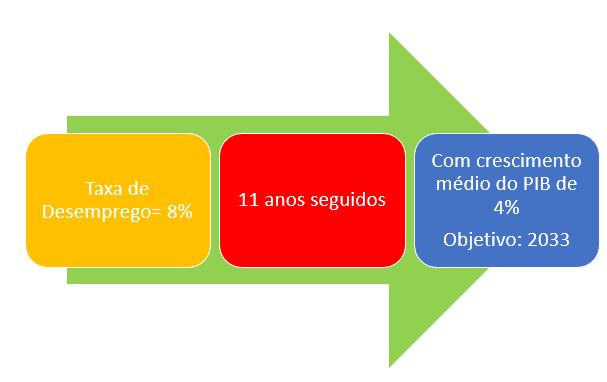
Therefore, there is a problem here for the economic theories in which the government rests on its policy. To go down unemployment to acceptable levels, for example 8%, 11 years would be needed with an average growth of 4% per year. Only in 2033 would unemployment be at a satisfactory level for the well-being of the population.
Exemplification of the necessary to achieve an unemployment rate of 8% without state intervention
Alternative and complementary policies
It is possible that this reality was what led the newly deposed minister of state to the social area, Dalva Ringote, to announce the “redinamization” of several government social programs. Although it has not specifically referred to unemployment, it is assumed that training programs, education programs and fighting poverty are included in the portfolio of the minister’s concerns and begins to have some inflection in the passive orthodoxy of the fight against unemployment[8].
It is evident that there are no miracles, but there has to be a government effort to idealize a more active employment policy than the private sector and expected economic growth supplemented.
Essentially this policy would be based on three pillars:
EMPLOYMENT PLAN
i) The hiring of staff for the State for the coverage of fundamental needs in education, health and social solidarity. Here the focus would be the hiring of licensed staff to occupy positions of human Capital that reproduce social welfare;
ii) The grant to private companies to hire contract workers, giving preference to Angolans;
iii) the launch of vast professional training programs for unlicensed citizens to provide them with practical qualifications in agriculture and in several posts.
In order to finance these massive programs to fight unemployment, one would have to rely, in part, on budget surplus funds and, on the other hand, on the famous recovery of assets in the fight against corruption.
There is no doubt that much of the government’s future is based on what will be done in the employment area. This will really have to be the employment legislature.
[4] See a balanced description in Dagmar Brožová, Modern labour economics: the neoclassical paradigm with institutional content, Procedia Economics and Finance 30 (2015) 50 – 56.
As recentes eleições angolanas ocorridas a 24 de agosto de 2022 foram objeto de intenso escrutínio por parte da opinião pública angolana e internacional. Curiosamente uma boa parte da atenção foi dedicada a assuntos de índole política e/ou jurídica. Falou-se muito de tribunais, processos eleitorais, aplicação da lei, contagem de votos, alternância e mesmo revisão constitucional.
No entanto, os inquéritos qualitativos que um nosso parceiro executou durante o período eleitoral não apontaram essas como as principais preocupações dos angolanos, mas sim aquelas ligadas à economia, designadamente ao emprego e desemprego. O que os angolanos parecem pedir acima de tudo é emprego e boas condições de vida.
Consequentemente, a questão do desemprego é daquelas que mais importância tem na atividade do executivo que agora tomou posse.
Neste momento, os dados mais atuais apontam para uma taxa de desemprego geral de 30,2% (dados do Instituto Nacional de Estatística referentes ao II trimestre de 2022) e a taxa de desemprego jovem (15-24 anos) situar-se-á nos 56,7%[1]. A população desempregada com mais de 15 anos na totalidade do país está calculada em 4 913 481 de pessoas, enquanto os jovens de 15-24 desempregados serão 3 109 296.
Fonte: Instituto Nacional de Estatística de Angola
Mesmo que se duvidem das estatísticas e considerando o peso muito grande da economia informal, o que dificulta os cálculos, a realidade é que a taxa de desemprego é demasiado elevada. Aliás, é quase certo que a elevada taxa de desemprego juvenil contribuiu manifestamente para a derrota do MPLA em Luanda.
O desemprego é um dos mais graves e importantes problemas políticos, económicos e sociais de Angola.
Política de emprego do governo
A política do governo relativamente ao desemprego tem sido essencialmente passiva, embora acompanhada por alguns programas concretos.
Essencialmente, o governo espera que o esforço de estabilização macroeconómica (equilíbrio orçamental, controlo contas públicas, liberalização taxa de câmbio, etc) se traduzam num incentivo ao investimento privado que por sua vez fará aumentar o emprego.
O discurso de investidura do Presidente da República reafirmou essa aproximação quando afirmou que “Continuaremos a trabalhar em políticas e boas práticas para incentivar e promover o sector privado da economia, para aumentar a oferta de bens e serviços de produção nacional, aumentar as exportações e criar cada vez mais postos de trabalho para os angolanos, sobretudo para os mais jovens”[2](ênfase nosso).
O ministro de Estado para a Coordenação Económica, agora reconduzido, já tinha apontado este rumo quando ao referir-se ao desemprego e aos programas públicos de promoção de emprego, não os menciona concretamente, mas foca-se nos aspetos macroeconómicos. No início de setembro, Nunes Júnior avançava que estava confiante na redução do desemprego assente no sector privado, afirmando ter o governo conseguido “colocar o país no crescimento económico conferindo estabilidade cambial e nas reservas internacionais líquidas” e colocado “o país na rota do equilíbrio económico, da estabilidade cambial e das reservas internacionais”[3].
Não se contestam os sucessos do governo na área da estabilização das finanças públicas e política cambial, o que se duvida é da crença que o sector privado angolano tem capacidade imediata para resolver a questão do desemprego.
Na base desta política não interventiva na correção do desemprego excessivo está o modelo neoclássico que resume a essência de toda a atividade económica à interação livre entre oferta e procura mediada pela flexibilidade do preço. O modelo neoclássico tem uma relevância válida em muitas áreas da análise económica, mas certamente não será aplicável linearmente no mercado de trabalho[4] e ainda menos em Angola.
O governo continua a acreditar que basta criar as condições adequadas de enquadramento financeiro e cambial e o emprego aparece movido pelo sector privado.
Isto seria assim se Angola fosse uma economia de mercado livre com o sector privado forte e capitalizado. Angola não é nada disso. É uma economia que começou por um processo de destruição e sovietização após a independência em 1975 e cuja “liberalização” após 1992-2002, foi falsa, ou melhor, foi pós-soviética, imitando a mãe-Rússia: Alguns oligarcas ligados ao poder aproveitaram-se das privatizações e supostos mercados livres para rapidamente de “braço dado” com o poder político tomarem posições dominantes. Aliás, nunca houve verdadeiros empresários, mas essencialmente políticos empresários. E nunca existiu sector privado, mas sector de amigos do poder. Esta realidade não tem força para promover o emprego como quer o ministro.
Fazer depender, em Angola, a recuperação do emprego e o combate ao desemprego apenas do sector privado é impossível.
Há duas ordens de razões pelas quais a política contra o desemprego apenas assente no sector privado.
Em primeiro lugar o funcionamento do mercado. Regra geral o mercado de trabalho não funciona como um mercado livre obedecendo às regras da oferta e procura definidas pelo modelo económico neoclássico que parece sustentar a filosofia governamental, o comportamento do mercado de trabalho é tendencialmente rígido, dificilmente se baixam salários ou se despedem pessoas sem tumulto social e constrangimentos legais.
Em termos técnicos diz-se que o mercado de trabalho opera como um mercado sem compensação (non-clearing market)[5]. Enquanto de acordo com a teoria neoclássica a maioria dos mercados atinge rapidamente um ponto de equilíbrio sem excesso de oferta ou procura, isso não é verdade para o mercado de trabalho: pode haver um nível persistente de desemprego. A comparação do mercado de trabalho com outros mercados também revela diferenciais compensatórios persistentes entre trabalhadores similares.
Keynes no âmbito da crise dos anos 1930s estudou bem o assunto e concluiu que a economia poderia entrar em equilíbrios de subemprego, isto quer dizer que pode atingir um nível em que nunca vai empregar todos os potenciais trabalhadores e não sair daí sem a intervenção de uma “mão visível” que seria o Estado[6].
A segunda razão é a magnitude do desemprego em Angola. Uma coisa é esperar que o sector privado contrate pessoas quando o desemprego está a 10% e se pretende que desça para 6%.
É possível que um crescimento económico automaticamente aumente o emprego. A famosa lei de Okun[7], mesmo sendo imprecisa, diz-nos que uma subida de 2% do produto (PIB) implica uma descida de 1% do desemprego. Assim, se o PIB de Angola aumentasse 4% em 2023, o desemprego apenas desceria 2%, i.e., para 28%. Manifestamente insuficiente.
Explicitação da Lei de Okun
Portanto, há aqui um problema para as teorias económicas em que o governo assenta a sua política. Para descer o desemprego para níveis aceitáveis, por exemplo 8%, seriam precisos 11 anos com um crescimento médio de 4% ao ano. Só em 2033 o desemprego estaria a um nível satisfatório para o bem-estar da população.
Exemplificação do necessário para alcançar uma taxa de Desemprego de 8% sem intervenção do Estado
Políticas alternativas e complementares
É possível que esta realidade tenha sido o que levou a recém-empossada ministra de Estado para a área social, Dalva Ringote, a anunciar a “redinamização” de vários programas sociais do governo. Embora não se tendo especificamente referido ao desemprego, presume-se que programas de formação, educação ao longo da vida e combate à pobreza estejam incluídos no portefólio das preocupações da ministra e comece a haver alguma inflexão na ortodoxia passiva do combate ao desemprego[8].
É evidente que não há milagres, mas tem de haver um esforço do governo para idealizar uma política de emprego mais ativa que suplemente o sector privado e o previsto crescimento económico.
Essencialmente essa política assentaria em três pilares:
PLANO DE EMPREGO
a contratação de quadros para o Estado para a cobertura das necessidades fundamentais em educação, saúde e solidariedade social. Aqui o foco seria a contratação de quadros licenciados para ocupar posições de capital humano que reproduzissem o bem-estar social;
O subsídio às empresas privadas para procederem à contratação de trabalhadores a contrato, dando preferência a angolanos;
O lançamento de programas vastos de formação profissional de não-licenciados para os dotar de qualificações práticas na agricultura e nos ofícios variados.
Para financiar estes programas massivos de luta contra o desemprego ter-se-ia, em parte, de contar com os fundos superavitários do orçamento e noutra parte com as famosas recuperações de ativos do combate contra a corrupção.
Não permaneçam dúvidas que muito do futuro do governo assenta naquilo que for feito na área do emprego. Esta terá mesmo de ser a legislatura do emprego
[4] Ver uma descrição equilibrada do tema em Dagmar Brožová, Modern labour economics: the neoclassical paradigm with institutional content, Procedia Economics and Finance 30 ( 2015 ) 50 – 56.
https://www.cedesa.pt/wp-content/uploads/2022/09/emprego.jpg445800CEDESA-Editorhttps://www.cedesa.pt/wp-content/uploads/2020/01/logo-CEDESA-completo-W-curvas.svgCEDESA-Editor2022-09-28 09:00:002022-09-21 12:31:50Angola: A legislatura do emprego
There is an undeniable fact. Angolan elections scheduled for the 24th of August are the most disputed of the post-civil war (2002)[1]. Never has been a discussion so renamed and the intensity of the arguments and uncertainty so debated.
Despite some tension and sometimes incendiary rhetoric, this electoral context represents a significant advance of the democratic struggle, which is expected not to go beyond from other forms of struggle.
One of the innovative aspects that has arisen in these elections is the plurality of polls. As much as memory and files allow to determine, the existence of polls was not a usual fact in the previous Angolan elections.
In fact, in 2017, only one reference came up to a supposed poll made by the Brazilian company “Sensus, Pesquisa e Consultoria”. The existence of this poll was never confirmed, but at the time sources revealed that this entity would have learned that the MPLA would gain only 38 percent of the votes. UNITA would obtain 32 percent of voting intentions, while the Casa-CE would appear very close to Unita, with 26 percent. From this it would result that the majority in the National Assembly would be the opposition[2].
What is certain is that this poll has never been confirmed and the final results were quite different. As is well known, the MPLA had 61.05%, while Unita and Casa-CE reached 26.72% and 9.49% of the votes, far from what the supposed poll stated.
2-The polls in the 2022 elections
If the 2017 elections revolved around a ghost survey that had nothing to do with the final reality in 2022, unlocked public polls appear, although fought by the forces that do not like the results.
It is about these polls and the possibility of predicting an end result based on them that this analysis is leaning.
We follow the identification of polls by a Portuguese Cable Channel[3] and consider five published polls. These are:
All of these entities have their site and present the results publicly.
We do not ignore that there are several controversies around some of these entities, however, we chose to rely on the technical records of each of the polls and the good faith of the interveners. Let’s look at the message and not “kill the messenger.”
In fact, with the exception of Afrobarometer, all other entities are reasonably recent and seem to be dedicated to present Angolan elections, containing professionals from other companies or organizations. This is a sign of democratic liveliness and therefore does not deserve criticism. What is certain is that these entities after the first essay that are these elections in Angola will be perfecting to contribute to the democratic discourse in Angola.
Looking at the data sheets of each of the polls and results we will make a measure of the results following two criteria, the reliability of the method and the normal Gaussian distribution.
First, the type of inquiry performed. From the technical records and affirmations of those responsible we conclude that Mudei and Afrobarometer do random street surveys based on premises that specify in their methodology pages. In turn, Angopolls and PoBBrasil perform telephone inquiries according to a random computed selection. Angobarometro, on the other hand, performs online polls.
We understand that online surveys are not reliable because they benefit from a “neighborhood effect”, that is, there is a tendency to call friends and people who think the same way to visit the site. Therefore, if a site is taken as closer to UNITA will call more people from UNITA, having a bias in its favor, the same happening if the site is MPLA. To this extent, we believe that online polls demonstrate a party’s ability to mobilize, but not the voting intentions of a random sample of the population.
We thus remove the AngoBarometro from this appreciation.
Regarding the remaining four, we proceed to a Gaussian distribution by eliminating the extremes and maintaining the standard-normal distribution. To this extent we will not consider the POBBrasil Survey that gives the MPLA an extreme victory, and also Mudei that gives UNITA an extreme victory.
3-Standard-polls
There are two polls that seem to us the most standardized: Afrobarometer and Angopolls.
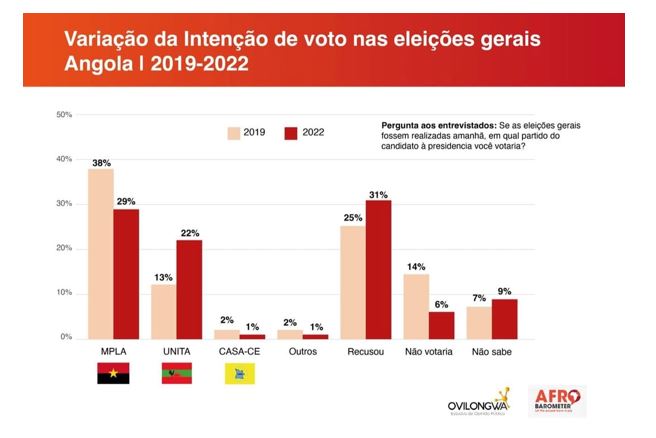
Afrobarometer’s technical record reveals that: “The Afrobarometer team in Angola, led by Ovilongwa – Public Opinion Studies, interviewed 1,200 adult Angolans, between February 9 and March 8, 2022. A sample of this size produces national results with one Error margin of +/- 3 percentage points and a confidence level of 95%. The previous research in Angola was conducted in 2019”.
The results achieved are presented in the table below:
Table No. 1- Afrobarometer results
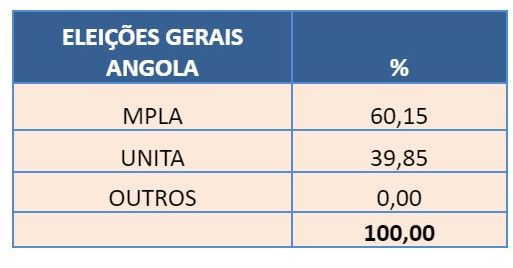
Angopolls has conducted several inquiries since December 2021. We will focus on the last of the published sequence, “VII-General Elections poll. July 2022”. Its datasheet states that: “The poll was made by telephone. 5040 valid inquiries were obtained, 21.03% of respondents were female.”
The results obtained were as follows:
Table No. 2: Angopolls results
¹ Not accounting for undecided and abstentions.
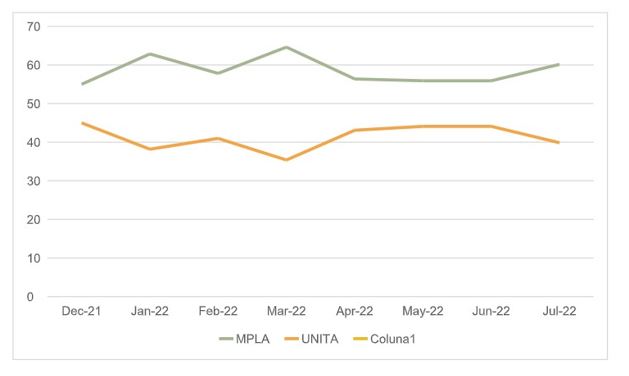
The Angopolls page also contains a curious chart with the presentation of the evolution of results over the several months:
Table No. 3- Voting Trends According to Angopolls
In a first analysis, it would seem that Afrobarometer and Angopolls polls give different results. In fact, the presentation of Afrobarometer attributes 29% to the MPLA and 22% to UNITA, while Angopolls refers to a percentage of 60.15% to the MPLA and 39, 85% for Unita. It appears to be a very large difference between the two polls.
However, a thinner analysis reveals that this is not the case.
In the end, in essence, the two entities came to very similar results: MPLA wins and UNITA reinforces its result, and even in percentages the difference is not very significant. The explanation for the apparent difference that does not exist is in the methods of presentation of the results and not in the results themselves.
If we notice Angopolls withdraws from their presentation the non-response (abstentionists, undecided on whether they would vote, etc.), while Afrobarometer does not do so. Note that they keep 46% – don’t know, don’t vote, refused to answer.
Now if we apply the same criterion for both polls, that is, removing the do not know, don’t vote, refused to answer, the so -called non-responders we will have a significant approximation between the two polls that mirror the table below:
Table No. 4: Comparative results Afrobarometer and Angopolls Following the same method of presentation
It is evident that another method for considering non-response is to impute them according to historical criteria (that is, considering the meaning of voting in previous elections) to political forces or then you can go into several speculative exercises.
Conclusions
What results from this analysis is that normal predictability points to a victory of MPLA in a percentage that oscillates between 54% and 61% and a substantial reinforcement of UNITA to 40%, with a sharp decrease of other political forces, what is called in political science a bipolarization.
It should be noted, however, that giving the percentage of non-respondents, these numbers are not fixed and definitive. They are a photograph at a given moment, but everything can change.
Therefore, polls give some indications, mark trends, but do not give certainty. As mentioned at the beginning of this work, this is an area of democracy that only now begins to be explored, so you can’t expect definitive answers, but only mutable observations.
[1] In this analysis it is not included the 1992 elections because they were conducted in a historically very different context.
[4] Due to rounding adjustments it doesn’t equal 100 %
https://www.cedesa.pt/wp-content/uploads/2022/08/image.png302619CEDESA-Editorhttps://www.cedesa.pt/wp-content/uploads/2020/01/logo-CEDESA-completo-W-curvas.svgCEDESA-Editor2022-08-17 11:00:002022-08-17 15:05:51Elections in Angola: polls and results predictions
Há um facto indesmentível. As presentes eleições angolanas marcadas para o próximo dia 24 de Agosto são as mais disputadas de sempre do pós-guerra civil (2002[1]). Nunca uma discussão foi tão renhida e a intensidade dos argumentos e incerteza tão debatida.
Apesar de alguma crispação e, por vezes, retórica incendiária, este contexto eleitoral representa um avanço significativo da luta democrática, que se espera que não extravase para outras formas de luta.
Um dos aspectos inovadores que tem surgido nestas eleições é a pluralidade de sondagens. Tanto quanto a memória e os arquivos permitem apurar, a existência de sondagens não era um facto habitual nas anteriores eleições angolanas.
Na verdade, em 2017, apenas surgiu uma referência a uma suposta sondagem efectuada pela empresa brasileira Sensus, Pesquisa e Consultoria. A existência dessa sondagem nunca foi confirmada, mas na altura fontes revelavam que essa entidade teria apurado que o MPLA ganharia apenas 38 por cento dos votos. A UNITA obteria 32 por cento das intenções de voto, enquanto a CASA-CE surgiria colada à UNITA, com 26 por cento. Daqui resultaria que a maioria na Assembleia Nacional seria da oposição.[2]
O certo é que esta sondagem nunca foi confirmada e os resultados finais foram bem diferentes. Como se sabe, o MPLA teve 61.05%, enquanto a UNITA e a CASA-CE alcançaram 26.72% e 9.49% dos votos, bem longe do que aquilo que a suposta sondagem afirmava.
2-As sondagens nas eleições de 2022
Se as eleições de 2017 giraram à volta duma sondagem-fantasma que nada teve a ver com a realidade final, em 2022, aparecem sondagens públicas não desmentidas, embora combatidas pelas forças que não gostam dos resultados.
É sobre essas sondagens e a possibilidade de se conseguir prever um resultado final com base nelas que se debruça esta análise.
Seguimos a identificação de sondagens realizada por um canal de cabo português[3] e consideramos cinco sondagens publicadas. São elas:
Todas estas entidades têm o seu site e apresentam os resultados publicamente.
Não ignoramos que existem várias polémicas à volta de algumas destas entidades, contudo, optámos por nos basear nas fichas técnicas de cada uma das sondagens e na boa-fé dos intervenientes. Vamos olhar para a mensagem e não “matar o mensageiro”.
Na realidade, com a excepção da Afrobarometer, todas as restantes entidades são razoavelmente recentes e parecem estar vocacionadas para as presentes eleições angolanas, contendo profissionais provenientes de outras empresas ou organizações. Isso é um sinal de vivacidade democrática e por isso não merece crítica. O certo é que estas entidades depois do primeiro ensaio que são estas eleições em Angola se irão aperfeiçoar a contribuir para o discurso democrático em Angola.
Olhando para as fichas técnicas de cada uma das sondagens e resultados vamos proceder a uma aferição dos resultados seguindo dois critérios, o da fiabilidade do método e da distribuição normal gaussiana.
Em primeiro lugar, o tipo de inquérito realizado. Pelas fichas técnicas e afirmações dos responsáveis concluímos que o Mudei e a Afrobarometer fazem inquéritos de rua aleatórios baseados em premissas que especificam nas suas páginas de metodologia. Por sua vez a Angopolls e POBBrasil realizam inquéritos telefónicos segundo uma selecção computadorizada aleatória. Já a Angobarometro efectua sondagens online.
Entendemos que os inquéritos online não são fiáveis pois beneficiam dum “efeito vizinhança”, isto é, há uma tendência de chamar os amigos e pessoas que pensam da mesma forma para visitar o site. Portanto, se um site é tido como mais próximo da UNITA chamará mais pessoas da UNITA, havendo um enviesamento a seu favor, o mesmo acontecendo se o site é do MPLA. Nessa medida, acreditamos que as sondagens online demostram a capacidade de mobilização de um partido, mas não as intenções de voto de uma amostra aleatória da população.
Retiramos, assim, a Angobarometro desta apreciação.
Em relação às quatro restantes, procedemos a uma distribuição gaussiana eliminando os extremos e mantendo a distribuição padrão-normal. Nesta medida não consideraremos a sondagem POBBrasil que dá uma vitória extrema ao MPLA, como a Mudei que dá uma vitória extrema à UNITA.
3-Sondagens-padrão
Ficam duas sondagens que nos parecem as mais padronizadas: Afrobarometer e Angopolls.
A ficha técnica da Afrobarometer revela que: “A equipa do Afrobarometer em Angola, liderada pela Ovilongwa – Estudos de Opinião Pública, entrevistou 1.200 Angolanos adultos, entre 9 de Fevereiro e 8 de Março de 2022. Uma amostra deste tamanho produz resultados nacionais com uma margem de erro de +/- 3 pontos percentuais e um nível de confiança de 95%. A pesquisa anterior em Angola foi realizada em 2019”.
Os resultados alcançados são apresentados no quadro abaixo:
Quadro n.º 1- Resultados Afrobarometer
A Angopolls realizou vários inquéritos desde Dezembro de 2021.Vamos focar-nos no último da sequência publicado, “VII – SONDAGEM ELEIÇÕES GERAIS. JULHO 2022”. A sua ficha técnica refere que: “A sondagem foi feita telefonicamente. Foram obtidos 5040 inquéritos válidos, sendo que 21,03% dos inquiridos eram do sexo feminino.”
Os resultados obtidos foram os seguintes:
Quadro n.º 2: Resultados Angopolls
¹Não contabilizando indecisos e abstenções.
A página da Angopolls também contém um gráfico curioso com a apresentação da evolução dos resultados ao longos dos vários meses:
Quadro n.º 3- Tendências de voto segundo Angopolls
Numa primeira análise parceria que as sondagens Afrobarometer e Angopolls dão resultados diferentes. De facto, a apresentação da Afrobarometer atribui 29% ao MPLA e 22% à UNITA, enquanto a da Angopolls refere uma percentagem de 60,15% para o MPLA e 39,85% para UNITA. Afigura-se uma diferença muito grande entre as duas sondagens.
Contudo, uma análise mais fina revela que não é assim.
No final de contas, na sua essência, as duas entidades chegaram a resultados muito semelhantes: o MPLA ganha e a UNITA reforça, e mesmo em percentagens a diferença não é muito significativa. A explicação para a aparente diferença que não existe está nos métodos de apresentação dos resultados e não nos resultados propriamente ditos.
Se repararmos a Angopolls retira da sua apresentação os Não Respondentes (abstencionistas, indecisos sobre se iriam votar, etc), enquanto a Afrobarometer não faz isso. Note-se que mantêm 46% de Não sabe, Não Vota, Recusou.
Ora se aplicarmos o mesmo critério para ambas as sondagens, isto é, retirando os Não Sabe, Não Vota, Recusou, os chamados não respondentes teremos uma significativa aproximação entre as duas sondagens que se espelha no quadro abaixo:
Quadro n.º 4: Resultados comparados Afrobarometer e Angopolls seguindo o mesmo método de apresentação
É evidente que outro método para considerar os não respondentes é imputá-los segundo critérios históricos (isto é, considerando o sentido de voto em anteriores eleições) às forças partidárias ou então pode-se entrar em exercícios especulativos variados.
Conclusões
O que resulta da análise que fazemos das sondagens é que a previsibilidade normal aponta para uma vitória do MPLA numa percentagem que oscila entre os 54% e os 61% e um substancial reforço da UNITA para 40%, havendo uma diminuição acentuada dos outros partidos, aquilo a que se chama em ciência política uma bipolarização.
Note-se, contudo, que atendendo à percentagem de Não Respondentes, estes números não são fixos e definitivos. São uma fotografia em dado momento, mas tudo pode mudar.
Portanto, as sondagens dão algumas indicações, marcam tendências, mas não dão certezas. Como se referiu no início deste trabalho, esta é uma área da democracia que só agora começa a ser explorada, portanto, não se podem esperar respostas definitivas, mas apenas observações mutáveis.
[1] Não se inclui nesta análise qualquer referência às eleições de 1992, por terem sido conduzidas num contexto historicamente muito diferente.
https://www.cedesa.pt/wp-content/uploads/2022/08/image.png302619CEDESA-Editorhttps://www.cedesa.pt/wp-content/uploads/2020/01/logo-CEDESA-completo-W-curvas.svgCEDESA-Editor2022-08-17 09:00:002022-08-17 15:05:39Eleições em Angola: sondagens e previsões de resultados
The starting point for this study is the statement of a renowned researcher during the II International Congress of Angolanistics according to whom the “next elections in Angola should be the least transparent and credible.”[1]
It is recalled that Angola had its first elections in 1992, after which there was a resurgence of the civil war that ended in 2002, and it only held elections again in 2008, followed by electoral acts in 2012 and 2017, so far, four electoral processes in Angola.
The next elections are scheduled for August 24, 2022.
In all the elections whose count has reached the end, the MPLA, the party in government since independence in 1975, won with the following results: 1992- 53.74%; 2008- 81.76%; 2012-71.84%; 2017- 61.05%.
Table no. 1- Winner of the elections in Angola (1992-2017)
1992
MPLA
53,74%
2008
MPLA
81,76%
2012
MPLA
71,84%
2017
MPLA
61,05%
Interestingly, in every election, even in 1992[2], which had wide international coverage and had over 400 foreign observers, the main opposition party alleged fraud.
In 1992, these allegations resulted in renewed civil war and undisguised massacre and violence. In fact, the resolution of the dispute only took place with the death of the opposition leader and the end of the war in 2002. In the other elections, there was final acceptance of the results and integration into the constitutional-legal functioning.
In 2008, 90 observers from the European Union were present, and the MPLA’s victory was overwhelming. It was, in fact, the time of the oil boom. Even so, the opposition claimed fraud, and demanded a repetition of the elections due to delays that marked the process, described by the opposition leader as “a disaster”, with numerous delays across the country. In any case, despite these protests, the elections were eventually accepted and the deputies took their seats. This time there was no war and a certain democratization of public life began.
2012 was again the year of elections, and again, there were reports of irregularities, but without the vocality of the past. The opposition took their seats in parliament and played their part.
In the year 2017, the African Union sent observers to the elections, with the aim of guaranteeing democratic elections, but the European Union decided not to send a large team of observers. The opposition contested the results, but ended up accepting them after decisions by the Constitutional Court that validated the elections.
There are patterns that repeat themselves. The first two are obvious, the victory of the MPLA and the permanent contestation of the process by the opposition. There is also the intervention of external observers, for example 400 in 1992.
Despite repeated accusations of fraud on the part of the defeated candidates, what is certain is that, with the exception of 1992, they always ended up accepting the results and taking their seats in the National Assembly.
Comparisons: Transparency and Democracy in 2022
The question that we are going to answer is whether the present elections, scheduled for August 24, 2022, represent a decrease in the electoral conditions of the past, as some researchers claim, or if, on the contrary, even though they are not perfect, they present a clear evolution in terms of transparency and democracy?
To assess the conditions, we will review current legislation, as well as the characteristics of the current public scrutiny compared to the past, as we believe that this is the realistic critical mechanism to assess the transparency of elections.
Legislation
Regarding the legislation in force, there are some aspects to emphasize, many of which have been the target of misunderstandings or not very literal interpretations. Elections are now regulated by Law No. 30/21 of 30 December, which amended Law No. 36/11 of 21 December — Organic Law on General Elections (OLGE). In the current legislation we have to highlight the following topics that focus on the electoral process:
i) Basic conditions: demonstration, right to broadcast and financing
During the electoral campaign period, freedom of assembly and demonstration for electoral purposes is governed by the provisions of the general law applicable to the exercise of freedom of assembly and demonstration, with the following specificities (article 66 of the OLGE):
a) Processions and parades may take place on any day and time, respecting only the limits imposed by freedom of work, maintenance of calmness and public order, freedom and traffic management, as well as respect for the period of citizens’ rest.
b) The presence of public authority agents at meetings and events organized by any candidate can only be requested by the competent bodies of the applications, with the organizing entity responsible for maintaining order when such a request is not made.
c) The communication to the competent administrative authority of the area about the intention to promote a meeting or demonstration is made at least 24 hours in advance.
What results from the law is a broad possibility of demonstration, with no constraints or noticeable obstacles.
It should be noted, moreover, that in the pre-campaign period there have already been large demonstrations without incident, either by the government party or by the opposition.
The opposition leader has moved freely in the territory from north to south, specifically, from Cabinda to Menongue and carried out large mass acts, without any impediment or confrontation. This fundamental aspect for the electoral process has been ensured.
In relation to the right to broadcast, article 73 of the OLGE provides that candidates for general elections are entitled to use the public broadcasting and television service, during the official period of the electoral campaign, in the following terms: a) Radio: 10 minutes a day between 3 pm and 10 pm; b) Television: 5 minutes a day between 6 pm and 10 pm.
The law guarantees what we might call the minimum amount of political intervention during the electoral campaign period.
The global funding of all political parties carried out by the State is also provided for and is imperative under the terms of article 81 of the OLGE, which provides that the State will allocate an amount to support the electoral campaign of candidates for the general elections, which is distributed equitably, and it can be used to support the List Delegates.
The letter of the law offers sufficient guarantees that certain minimums of equity and competition between parties are upheld for the 2022 elections[3].
ii) Voting and counting of votes
This is an area where there has been a lot of discussion and perhaps misunderstandings or misinterpretations. Therefore, it is important to underline the essential provisions of the law.
Firstly, polling stations, contrary to what one might think in light of some published analyses, play a central role in the process. From the outset, the List Delegate present at the Polling Station can request clarifications and submit, in writing, complaints regarding the electoral operations of the same Polling Station and instruct them with the appropriate documents, and the Polling Station cannot refuse to receive the complaints, and must initial them and attach them to the minutes, together with the respective resolution, whose knowledge will be given to the claimant. (Article 115 of the OLGE).
This means that there is a direct inspection by each of the parties in each of the Polling Stations. What we might call an atomist oversight. Every atom of the election is being verified.
Afterwards, it is still at the Polling Station that the polls are opened and the votes are counted, also contrary to what has been stated.
In fact, once voting is over, the Chairman of the Board, in the presence of the other members, opens the ballot box, followed by the counting operation in order to verify the correspondence between the number of Voting Ballots in the ballot box and the number of voters who voted at that Polling Station. (Article 120 of the OLGE).
Then, the President of the Polling Station orders the counting of the Ballots, respecting the following rules:
a) The President opens the bulletin, displays it and reads it aloud;
b) The first scrutineer records the votes allocated to each party on a sheet of white paper or, if available, on a large board;
c) The second scrutineer places, separately and in batches, after displaying them, the already read votes corresponding to each of the parties, the blank votes and the null votes;
d) The first and third tellers proceed to the counting of the votes and the Chairman of the Board to divulge the number of votes that fell to each party.
After this operation, which is well detailed in the law, the President of the Polling Station compares the number of votes in the ballot box and the sum of the number of votes for each lot. The List Delegates have the right to verify the lots without being able to complain in case of doubt to the Chairman of the Board who analyzes the complaint. (Article 121 of the OLGE).
Consequently, we have an electoral act that is supervised and the votes are counted locally at each Polling Station with the presence of delegates from each party.
This is what the law defines.
After this local operation, a Minute of the Polling Station is drawn up by the Secretary of the Table and duly signed, in legible handwriting, by the President, Secretary, Tellers and by the List Delegates who have witnessed the voting, being then placed in a sealed envelope that must be duly forwarded, by the quickest route, to the Provincial Electoral Commission. (Article 123 of the OLGE). Subsequently, the National Electoral Commission is responsible for centralizing all the results obtained and for distributing the mandates (article 131 of the OLGE). In summary, the national tabulation is based on the summary minutes and other documents and information received from the Polling Stations (article 132 of the OLGE).
It can thus be seen that the counting of results is carried out at the local level, with no centralization of the opening of the polls or the counting, the centralization is carried out a posteriori, based on the results obtained at the Polling Stations.
Looking at the legal provisions mentioned above, a transparent and properly supervised mechanism can be seen at the local level.
Added to this mechanism is the rule of article 116 of the OLGE which makes it mandatory that the technologies to be used in the scrutiny activities meet the requirements of transparency and security.
The same rule requires the audit of source programs, data transmission and processing systems and control procedures and makes it imperative that before the beginning of each election, the Plenary of the National Electoral Commission carry out an independent, specialized technical audit, for public tender, to test and certify the integrity of source programs, data transmission and processing systems and control procedures to be used in tabulation and scrutiny activities at all levels.
iii) The transparency of the President of the Republic election
The Voting Ballot is printed in color, on smooth and non-transparent paper, in a rectangular shape with the appropriate dimensions so that it can fit all the candidacies admitted to the vote and whose spacing and graphic presentation do not mislead voters in the exact identification and signage of the application one has chosen.
The serial number, the statutory designation of the political party, the name of the candidate for President of the Republic and the respective passport-type photograph, the acronym and the symbols of the political party or coalition of political parties, arranged vertically, are printed on each Ballot, one below the other, in the order of the draw carried out by the National Electoral Commission, after the approval of the candidacies by the Constitutional Court (article 17 of the OLGE).
This means that despite the presidential election method chosen by the Constitution, voters clearly know who they are voting for for President of the Republic. It has the face and name indicated.
iv) Electoral litigation
The assessment of the regularity and validity of elections is ultimately the responsibility of the Constitutional Court (article 6 OLGE). This rule commits the Constitutional Court (CC) all final decisions on elections, not the National Electoral Commission (NEC).
The fact that the CC has the final word and not the NEC is an added jurisdictional guarantee. At the present time, as we will see later, this is relevant because the CC has been the subject of a great deal of public scrutiny, making it more difficult to make decisions that have no legal basis.
Public Scrutiny
It is natural, above all for the supporters of a realistic vision of the law[4], in which we include ourselves, according to which what is important is not what is written in the law, nor even the meta-legal principles on which it is based, but its application and practical result, one is not satisfied with the mere legal enumeration, even if it appears well constructed and promising, as it seems to us to be the case with the present Organic Law on General Elections.
It is necessary to invoke other real factors that allow a more objective assessment of the electoral phenomenon in Angola, as expected for 2022.
We understand that the key factor is the public scrutiny that the electoral process is having. Public scrutiny understood as a thorough examination and diligent investigation of a phenomenon carried out by society in general, and not just by specific bodies that may or may not be aligned with a given political or ideological option.
Our argument is that the greater the public scrutiny to which an electoral phenomenon is subject, the greater its transparency and democracy and the lower the probabilities of fraud, with a direct relationship between scrutiny and transparency.
Now, the brief excursus that we carried out on the several elections that took place in Angola, and removing the one from 1992, which due to its specificity and historical context has no place in this comparison, and considering that some of our contributors personally followed the 2012 and 2017 elections, allows us to advance with some trends in relation to aspects of scrutiny by members of civil society or non-political structuring bodies of the community. These themes lead us to a qualitative comparison between 2008 and 2017.
First, let’s highlight the Catholic Church. Possibly, as a result of certain accusations of collaboration with the colonial power and some clash with the post-independence Marxist ideology, the Catholic Church, in general, had committed itself in the previous elections to a discreet and little public intervention role, not contributing for a strong debate about the electoral process in the previous elections (2008 to 2017).
This will not happen in 2022, following in the footsteps of its counterpart in the neighboring Democratic Republic of Congo (DRC) in which the Catholic Church played a decisive role in the 2018/2019 electoral transition between Kabila and Tshisekedi, the Angolan Catholic Church has adopted a manifesto leading role in the preparation of the Angolan elections. Its bishops and priests are active in their pastoral care and in their homilies and have an intense public activity, demanding adequate elections[5].
It is precisely this Catholic activism, bearing in mind that according to statistics, around 40% of the Angolan population is Catholic[6], which allows us to conclude that the scrutiny that the Catholic Church is carrying out of the elections will not leave a large part of the population indifferent and obliges by itself to increased transparency in the process. In other words, Catholic scrutiny and its multiple organizations is, in itself, an intrinsic factor of transparency.
A second factor that we notice different in relation to other Angolan elections is the role of social networks. These will cover about a quarter of the voting population[7], but perhaps more of those who actually vote. By frequenting social networks, one can easily glimpse the intensity with which they talk about the elections and how they discuss their realization and the need for transparency. A candidate for deputy for the opposition party and activist constantly present on the networks like Hitler Samussuku has 52,000 followers on Facebook and his posts often reach more than 1000 likes. This is just a random example, but many others could be mentioned.
Never before have social networks in Angola been so alive and active as in this period, contesting, discussing and affirming positions.
As in the situation of the Catholic Church, we understand that this digital scrutiny has a double function. By itself it is synonymous with transparency and at the same time it increases transparency by placing the discussion on the elections in the public space.
We have here two factors intrinsically conducive to electoral transparency: the activism of the Catholic Church and digital activism.
Finally, it is worth mentioning the issue of international observers. In the difficult year of 1992, according to public information, 400 international observers were present[8], in 2017, more than 1000 observers will have been present[9], currently, according to publications that have focused on the subject, 2000 national observers are expected for 2022 and an undisclosed number of international observers. It should be said that in view of the aforementioned activism of the Church and in the digital world, national observers will play a very intense role, contrary to what could happen in the past.
Conclusions
The issue we studied here is not the platonic perfection of the Angolan elections, but the evolution of electoral transparency since 2008 with the forecast for 2022.
What we have found, taking into account two indices, legislation and public scrutiny, is that, at the moment, there is a law strong enough to hold free and fair elections, and that public scrutiny, namely by the Catholic Church and its satellite organizations and also through social networks, has never been as high as it is today.
To that extent, even with imperfections, it is expected that these elections will be more transparent than in the past, because if this does not happen, public opinion will feel better and more deeply than in the past.
[3] We do not discuss in this work the problem of public service imbalance in the pre-campaign period. It will possibly be the object of another study pointing out solutions and needs for a holistic view of the situation encompassing all sources of news: public, private, foreign and digital.
[4] See for exemple Rui Verde, Juízes: o novo poder, 2015.
https://www.cedesa.pt/wp-content/uploads/2022/06/28263904.jpg10801920CEDESA-Editorhttps://www.cedesa.pt/wp-content/uploads/2020/01/logo-CEDESA-completo-W-curvas.svgCEDESA-Editor2022-06-29 12:53:002022-06-23 17:59:15Theories of electoral fraud, legislation and public scrutiny in Angola
O ponto de partida para este estudo é a afirmação de uma conceituada investigadora durante o II Congresso Internacional de Angolanística segundo a qual as “próximas eleições em Angola deverão ser as menos transparentes e credíveis.”[1]
Recorde-se que Angola teve as suas primeiras eleições em 1992, após o que existiu um recrudescimento da guerra civil que terminou em 2002, e apenas voltou a ter eleições em 2008, a que se seguiram atos eleitorais em 2012 e 2017. Houve, portanto, até ao momento, quatro processos eleitorais em Angola.
As próximas eleições estão previstas para 24 de Agosto de 2022.
Em todas as eleições cuja contagem chegou ao final, o MPLA, partido no governo desde a independência em 1975 saiu vencedor com os seguintes resultados: 1992- 53.74%; 2008- 81,76%; 2012-71.84%; 2017-61.05%.
Quadro n. º1- Vencedor das eleições em Angola (1992-2017)
1992
MPLA
53,74%
2008
MPLA
81,76%
2012
MPLA
71,84%
2017
MPLA
61,05%
O interessante é que em todas as eleições, mesmo as de 1992[2], que tiveram ampla cobertura internacional e contaram com mais de 400 observadores estrangeiros, o principal partido da oposição alegou fraude.
Em 1992, dessas alegações resultou a renovação da guerra civil e um massacre e violência indisfarçáveis. Na verdade, a resolução da contenda só teve lugar com a morte do líder da oposição e o fim da guerra em 2002. Nas outras eleições acabou por haver aceitação final dos resultados e integração no funcionamento constitucional-legal.
Em 2008, estiveram presentes 90 observadores da União Europeia, e a vitória do MPLA foi esmagadora. Estava-se, aliás, na época do boom petrolífero. Mesmo assim a oposição clamou fraude, e exigiu a repetição das eleições devido aos atrasos que marcaram o processo, descrito pelo líder da oposição como “um desastre”, com inúmeras demoras por todo o país. Em todo o caso, apesar destes protestos, as eleições acabaram por ser aceites e os deputados tomaram os seus lugares. Desta vez não houve guerra e iniciou-se uma certa democratização da vida pública.
2012 foi novamente ano de eleições, e novamente, houve denúncia de irregularidades, mas sem a vocalidade do passado. A oposição tomou os seus lugares no parlamento e desempenhou o seu papel.
No ano de 2017, A União Africana enviou observadores para as eleições, com o objetivo de garantir as eleições democráticas, mas a União Europeia decidiu não mandar uma grande equipa de observadores. A oposição contestou os resultados, mas acabou por os aceitar após decisões do Tribunal Constitucional que validaram as eleições.
Há padrões que se repetem. Os dois primeiros são óbvios, a vitória do MPLA e a contestação permanente do processo pela oposição. Também se verifica intervenção de observadores externos, por exemplo 400 em 1992.
Apesar das acusações repetidas de fraude por parte dos candidatos derrotados, o certo, é que com a exceção de 1992, sempre acabaram por aceitar os resultados e tomar os seus lugares na Assembleia Nacional.
Comparações: Transparência e democraticidade em 2022
A questão que vamos responder é se as presentes eleições, marcadas para 24 de agosto de 2022, representam um decréscimo das condições eleitorais do passado, como afirmam alguns investigadores, ou se pelo contrário, mesmo não sendo perfeitas, apresentam uma manifesta evolução em termos de transparência e democraticidade.
Para avaliarmos as condições iremos proceder a uma revisão da legislação em vigor, bem como às características do atual escrutínio público face ao passado, pois acreditamos que este é o mecanismo crítico realista para aferir a transparência das eleições.
Legislação
Sobre a legislação em vigor há alguns aspetos a enfatizar, muitos dos quais têm sido alvo de equívocos ou interpretações pouco literais. As eleições estão agora reguladas pela Lei n.º 30/21 de 30 de dezembro, que alterou a Lei n.º 36/11, de 21 de dezembro — lei orgânica sobre as eleições gerais (LOEG). Na atual legislação temos de destacar os seguintes tópicos que se debruçam sobre o processo eleitoral:
i) Condições básicas: manifestação, direito de antena e financiamento
No período da campanha eleitoral, a liberdade de reunião e de manifestação para fins eleitorais rege-se pelo disposto na lei geral aplicável ao exercício das liberdades de reunião e de manifestação, com as seguintes especificidades (artigo 66.º da LOEG):
a) Os cortejos e desfiles podem realizar-se em qualquer dia e hora, respeitando-se apenas os limites impostos pela liberdade de trabalho, pela manutenção da tranquilidade e ordem públicas, pela liberdade e ordenamento do trânsito, bem como pelo respeito do período de descanso dos cidadãos.
b) A presença de agentes da autoridade pública em reuniões e manifestações organizadas por qualquer candidatura apenas pode ser solicitada pelos órgãos competentes das candidaturas, ficando a entidade organizadora responsável pela manutenção da ordem quando não faça tal pedido.
c)A comunicação à autoridade administrativa competente da área sobre a intenção de se promover uma reunião ou manifestação é feita com antecedência mínima de 24 horas.
O que resulta da lei é uma ampla possibilidade de manifestação, não havendo condicionalismos nem obstáculos assinaláveis.
Note-se aliás, que no período de pré-campanha já têm ocorrido grandes manifestações sem incidentes, quer por parte do partido do governo, quer por parte da oposição.
O líder da oposição tem-se deslocado livremente no território de norte a sul, concretamente, de Cabinda a Menongue e realizado grandes atos de massas, sem qualquer impedimento ou confronto. Este aspeto fundamental para o processo eleitoral tem estado assegurado.
Em relação ao direito de antena dispõe o artigo 73.º da LOEG que determina que as candidaturas às eleições gerais têm direito à utilização do serviço público de radiodifusão e televisão, durante o período oficial da campanha eleitoral, nos termos seguintes: a) Rádio: 10 minutos diários entre as 15 e as 22 horas; b) Televisão: 5 minutos diários entre as 18 e as 22 horas.
A lei garante aquilo que poderemos denominar como mínimos de intervenção política no período de campanha eleitoral.
Também o financiamento global de todos os partidos políticos efetuado pelo Estado está previsto e é imperativo nos termos do artigo 81.º da LOEG, que dispõe que o Estado atribuirá uma verba de apoio à campanha eleitoral das candidaturas às eleições gerais, que é distribuída de forma equitativa, podendo a mesma ser utilizada para apoio aos Delegados de Lista.
A letra da lei oferece suficientes garantias que determinados mínimos de equidade e concorrência entre partidos estão sustentados para as eleições de 2022[3].
ii) Votação e contagem dos votos
Esta é uma área em que tem havido muita discussão e talvez mal-entendidos ou interpretações erróneas. Portanto, é importante sublinhar as determinações essenciais da lei.
Em primeiro lugar, as mesas de voto, ao contrário do que se poderia pensar face a algumas análises publicadas, desempenham um papel fulcral no processo. Desde logo, o Delegado de Lista presente na Mesa de Voto pode solicitar esclarecimentos e apresentar, por escrito, reclamações relativas às operações eleitorais da mesma Mesa e instruí-los com os documentos convenientes, sendo que Mesa não pode recusar-se a receber as reclamações, devendo rubricá-las e apensá-las às atas, junto com a respetiva deliberação, cujo conhecimento será dado ao reclamante. (artigo 115.º da LOEG).
Isto quer dizer, que há uma fiscalização direta por cada um dos partidos em cada uma das Mesas de Voto. Aquilo a que poderíamos chamar uma fiscalização atomista. Cada átomo da eleição está a ser verificado.
Depois, é ainda na Mesa de Voto que se procede à abertura das urnas e contagem dos votos, também ao contrário do que tem sido afirmado.
Na verdade, encerrada a votação, o Presidente da Mesa, na presença dos restantes membros, procede à abertura da urna, seguindo-se a operação de contagem por forma a verificar a correspondência entre o número de Boletins de Voto existentes na urna e o número de eleitores que votaram naquela Mesa de Voto. (artigo 120.º da LOEG).
Em seguida, o Presidente da Mesa de Voto manda proceder à contagem dos Boletins de Voto, respeitando as seguintes regras:
a) O Presidente abre o boletim, exibe-o e faz a leitura em voz alta;
b) O primeiro escrutinador aponta os votos atribuídos a cada partido numa folha de papel branco ou, caso exista, num quadro grande;
c) O segundo escrutinador coloca em separado e por lotes, depois de os exibir, os votos já lidos correspondentes a cada um dos partidos, os votos em branco e os votos nulos;
d) O primeiro e o terceiro escrutinadores procedem à contagem dos votos e o Presidente da Mesa à divulgação do número de votos que coube a cada partido.
Terminada esta operação, bem detalhada na lei, o Presidente da Mesa de Voto procede ao confronto entre o número de votos existentes na urna e a soma do número de votos por cada lote. Os Delegados de Lista têm direito a verificar os lotes sem podendo reclamar em caso de dúvida para o Presidente da Mesa que analisa a reclamação. (artigo 121.º da LOEG).
Consequentemente, temos um ato eleitoral que é fiscalizado e os votos contados localmente em cada Mesa de Voto com a presença dos delegados de cada partido.
É isto que a lei define.
Após esta operação local, é elaborada uma ata da Mesa de Voto pelo Secretário da Mesa e devidamente assinada, com letra legível, pelo Presidente, Secretário, Escrutinadores e pelos Delegados de Lista que tenham presenciado a votação, sendo depois colocada em envelope lacrado que deve ser devidamente remetido, pela via mais rápida, à Comissão Provincial Eleitoral. (artigo 123.º da LOEG). Em sequência, compete à Comissão Nacional Eleitoral a centralização de todos os resultados obtidos e a distribuição dos mandatos (artigo 131.º da LOEG). Em síntese, o apuramento nacional é realizado com base nas atas-síntese e demais documentos e informações recebidas das Assembleias de Voto (artigo 132.º da LOEG).
Verifica-se assim que a contagem dos resultados é efetuada ao nível local, não havendo centralização da abertura de urnas nem das contagens, a centralização é realizada a posteriori, tendo como base os resultados obtidos nas Mesas de Voto.
Olhando para as disposições legais mencionadas vislumbra-se um mecanismo transparente e devidamente fiscalizado ao nível local.
A este mecanismo acresce que norma do artigo 116.º da LOEG que torna obrigatório que as tecnologias a utilizar nas atividades de escrutínio atendam aos requisitos da transparência e da segurança.
A mesma norma impõe a auditoria dos programas-fontes, dos sistemas de transmissão e tratamento de dados e dos procedimentos de controlo e torna imperativo que antes do início de cada eleição, o Plenário da Comissão Nacional Eleitoral realize uma auditoria técnica independente, especializada, por concurso público, para testar e certificar a integridade dos programas- -fontes, sistemas de transmissão e tratamento de dados e dos procedimentos de controlo a utilizar nas atividades de apuramento e escrutínio, a todos os níveis.
iii) A transparência da eleição do Presidente da República
O Boletim de Voto é impresso a cores, em papel liso e não transparente, de forma retangular com as dimensões apropriadas para que nele caibam todas as candidaturas admitidas à votação e cujo espaçamento e apresentação gráfica não induzam os eleitores em erro na identificação e sinalização exatas da candidatura por si escolhida.
Em cada Boletim de Voto são impressos o número de ordem, a designação estatutária do partido político, o nome do candidato a Presidente da República e a respetiva fotografia tipo passe, a sigla e os símbolos do partido político ou coligação de partidos políticos, dispostas verticalmente, umas abaixo das outras, pela ordem do sorteio efetuado pela Comissão Nacional Eleitoral, após a aprovação das candidaturas pelo Tribunal Constitucional (artigo 17.º da LOEG).
Isto significa que apesar do método de eleição presidencial próprio escolhido pela Constituição, o eleitor sabe manifestamente em quem está a votar para Presidente da República. Tem a face e o nome indicado.
iv) O contencioso eleitoral
A apreciação da regularidade e da validade das eleições compete, em última instância, ao Tribunal Constitucional (artigo 6.º LOEG). Esta norma comete o Tribunal Constitucional (TC) todas as decisões finais sobre eleições, não é a Comissão Nacional Eleitoral (CNE).
Ser o TC a ter a palavra final e não a CNE é uma garantia jurisdicional acrescida. No presente momento, como veremos adiante, isso tem relevo porque o TC tem sido objeto de um grande escrutínio público, sendo-lhe mais difícil, acreditamos, tomar decisões que não tenham fundamento legal.
Escrutínio Público
É natural, que sobretudo para os adeptos duma visão realista do Direito[4], em que nos incluímos, segundo a qual o importante não é o que está escrito na lei, nem sequer os princípios meta-legais em que esta assente, mas a sua aplicação e resultado prático, não se fique satisfeito com a mera enumeração legal, mesmo que esta surja bem construída e promissora, como se nos afigura acontecer com a presente Lei Orgânica das Eleições Gerais.
Torna-se necessário invocar outros fatores reais que permitam realizar uma avaliação mais objetiva do fenómeno eleitoral em Angola como esperado para 2022.
Entendemos que o fator chave é o do escrutínio público que o processo eleitoral está a ter. Escrutínio público entendido como exame minucioso e averiguação diligente de um fenómeno realizado pela sociedade em geral, e não apenas por órgãos específicos que poderão ou não estar alinhados com determinada opção política ou ideológica.
O nosso argumento é que quanto maior for o escrutínio público a que um fenómeno eleitoral esteja sujeito maior será a sua transparência e democracia e menores as probabilidades de fraude, havendo uma relação direta entre escrutínio e transparência.
Ora, o breve excurso que realizámos pelas várias eleições ocorridas em Angola, e retirando a de 1992, que pela sua especificidade e contexto histórico não tem lugar nesta comparação, e considerando que alguns dos nossos colaboradores acompanharam pessoalmente as eleições de 2012 e 2017, permite-nos avançar com algumas tendências em relação a aspetos escrutinadores por parte de integrantes da sociedade civil ou órgãos estruturantes não políticos da comunidade. Esses temas levam-nos a uma comparação qualitativa entre 2008 e 2017.
Em primeiro lugar, destaquemos a Igreja Católica. Possivelmente, fruto de certas acusações de colaboração com o poder colonial e de algum embate com a ideologia marxista pós-independência, a Igreja Católica, na sua generalidade, tinha-se remetido nas anteriores eleições a um papel discreto e pouco interventivo publicamente, não contribuindo para um forte debate acerca do processo eleitoral nas anteriores eleições (2008 a 2017).
Isso não acontece em 2022, seguindo as passadas da sua congénere na vizinha República Democrática do Congo (RDC) em que a Igreja Católica teve um papel determinante na transição eleitoral de 2018/2019 entre Kabila e Tshisekedi, a Igreja Católica angolana tem assumido um manifesto protagonismo na preparação das eleições angolanas. Os seus bispos e padres estão ativos na sua pastoral e nas homilias e têm uma atividade pública intensa, exigindo eleições adequadas[5].
É precisamente este ativismo católico, lembrando que segundo as estatísticas, cerca de 40% da população angolana é católica,[6]que permite concluir que o escrutínio que a Igreja Católica está a fazer das eleições não deixará larga parte da população indiferente e obriga por si só a uma transparência acrescida no processo. Melhor dizendo, o escrutínio católico e das suas múltiplas organizações é, em si mesmo, um fator intrínseco de transparência.
Um segundo fator que notamos diferente em relação às outras eleições angolanas é o papel das redes sociais. Estas abrangerão cerca de ¼ da população votante[7], mas talvez mais daqueles que efetivamente votam. Ora frequentando as redes sociais facilmente se vislumbra a intensidade com que falam das eleições e como discutem a sua realização e necessidade de transparência. Um candidato a deputado pelo partido da oposição e ativista constantemente presente nas redes como Hitler Samussuku tem 52.000 seguidores no Facebook e os seus posts alcançam muitas vezes mais de 1000 likes. Trata-se de um mero exemplo aleatório, mas muitos outros poderiam ser referidos.
Nunca as redes sociais em Angola estiveram tão vivas a ativas como neste período, contestando, discutindo e afirmando posições.
Tal como na situação da Igreja Católica entendemos que este escrutínio digital tem uma dupla função. Por si só é sinónimo de transparência e ao mesmo tempo aumenta a transparência ao colocar no espaço público a discussão sobre as eleições.
Temos aqui dois fatores conducentes intrinsecamente à transparência eleitoral: o ativismo da Igreja Católica e o ativismo digital.
Finalmente, convém referir a questão dos Observadores internacionais. No ano difícil de 1992 estiveram presentes, segundo informações públicas, 400 observadores internacionais[8], em 2017, terão estado mais de 1000 observadores[9],atualmente, segundo as publicações que se debruçaram sobre o assunto estão previstos 2000 observadores nacionais para 2022 e um número ainda não apurado de observadores internacionais. Convém dizer que atendendo ao ativismo acima referido da Igreja e no digital, os observadores nacionais terão um papel muito intenso ao contrário do que poderia acontecer no passado.
Conclusões
A questão que aqui estudámos não é da perfeição platónica das eleições angolanas, mas da evolução da transparência eleitoral desde 2008 com a previsão para 2022.
O que apurámos atendendo a dois índices, a legislação e o escrutínio público, é que, neste momento, existe uma lei suficientemente robusta para realizar eleições livres e justas, e que o escrutínio público, designadamente por parte da Igreja Católica e suas organizações satélite e também pelas redes sociais, nunca foi tão elevado como atualmente.
Nessa medida, mesmo com imperfeições, augura-se que estas eleições serão mais transparentes do que no passado, porque se tal não acontecer a opinião pública sentirá melhor e mais profundamente do que no passado.
[3] Não discutimos neste trabalho o problema do desequilíbrio do serviço público na época da pré-campanha. Será, possivelmente, objeto de outro estudo apontando soluções e necessidades de uma visão holística da situação englobando todas as fontes de notícias: públicas, privadas, estrangeiras e digitais.
[4] Ver por exemplo, Rui Verde, Juízes: o novo poder, 2015.
https://www.cedesa.pt/wp-content/uploads/2022/06/28263904.jpg10801920CEDESA-Editorhttps://www.cedesa.pt/wp-content/uploads/2020/01/logo-CEDESA-completo-W-curvas.svgCEDESA-Editor2022-06-29 09:02:002022-06-22 19:34:28Teorias da fraude eleitoral, legislação e escrutínio público em Angola
1- Framework: the requirements and agents of tourism promotion in Angola
Angola is gradually seeking to diversify its economy, choosing tourism as one of the main priorities for structuring economic policy. As is well known, the reconstruction started from 2002 did not focus on tourism, but on the oil, mining and construction industry. Once this model was exhausted, diversification became the keyword for development.
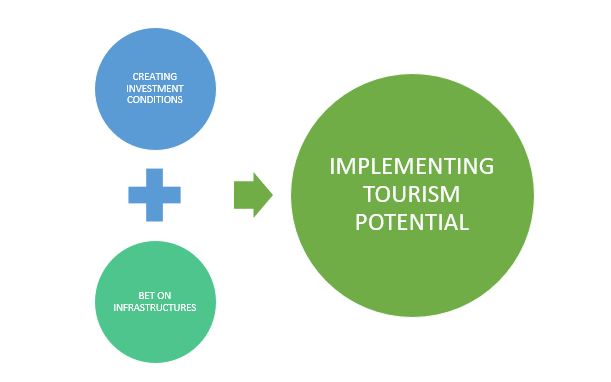
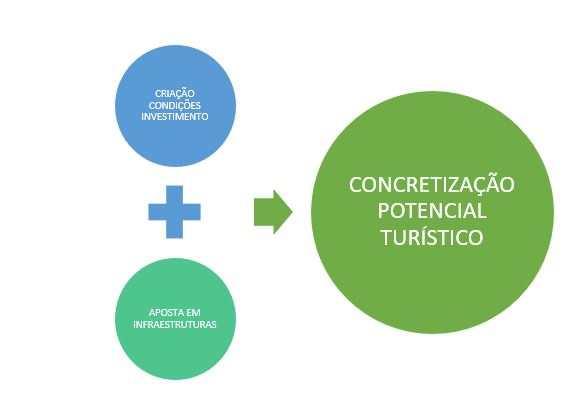
Since it is conspicuous that Angola has an enormous tourist potential, the truth is its implementation implies the removal of sveral obstacles and the creation of adequate conditions. We refer to two essential axes to create these conditions: the first is the creation of favorable conditions for investment in the tourism sector, this implies the review of the investment law that has already taken place, the removal of barriers to market entry and the facilitation of bank credit for new projects.
The second axis is of an infrastructural nature and requires the creation of an adequate transport network, roads, planes and boats, as well as a climate of criminal security, in addition to the facilitation of tourist visas.
Figure 1: The 2 axes for the development of tourism potential
Furthermore, the growth of tourism cannot be solely dependent on the State, it is naturally responsible for the regulation, supervision and creation of infrastructure and conditions. However, the fundamental role belongs to the private business community, which must advance and establish partnerships to enter the international circuits. And, finally, it is also up to the provincial, municipal and communal leaders to encourage and leverage their resources.
State, businessmen and local leaders form the tripartite partnership that must come together to launch tourism in Angola.
In 2019, at the opening of the World Tourism Forum that took place in Luanda, the President of the Republic made it very clear what the executive wanted for the sector: within the framework of the diversification of the economy, tourism should play a role in promoting development and generating income and employment. For this to materialize, the government should invest in the short and medium term, in the expansion of hotel infrastructures and in the infrastructure of the tourist centers of Cabo Ledo, Calandula and the Transfrontier Project of Okavango Zambeze, with the purpose of increasing the offer and the options diversity of tourists and customers in general[1].
Recently, a possible crisis in tourism in Europe has been discussed, admitting that Greece, Italy, France, Spain and Portugal are affected by the sanctions on Russia resulting from the war in Ukraine (which, in relation, at least to Portugal, is doubtful, as the country was not dependent on Russian tourism), Egypt has not yet fully recovered from fear of bomb attacks, Indonesia struggles to contain Muslim fundamentalism, India struggles with rising pollution levels, Kenya and Senegal could be invaded by Islamic agitation, favorite destinations like Turkey, Israel, Thailand and Dubai are somewhat saturated. This scenario is described in a somewhat emphatic way, however, it opens up opportunities for tourism in Angola, as it represents a certain verifiable trend.
The country has potential in tourism to attract tourists, as Cape Verde and Botswana did; it has paradisiacal beaches, desert and forests, rivers of great flow, mountains, exuberant fauna and flora, and, above all, a welcoming people and a rich and varied gastronomy.
2-Scenario of Angolan tourism
There is no developed tourism industry in Angola. The few areas that are developed took advantage of the country’s natural beauties, rivers, waterfalls and the 1,650 km of Atlantic coast. As the official brochures describe: “The humid tropical climate [of Angola] has created an exuberant flora and rich fauna spread over regions with forests, savannas, impressive mountains, rivers, beaches that seem to stretch without limits, waterfalls, oases and beautiful landscapes which seem to go on to infinity and are all immaculate and intact. An endless summer of warm afternoons bathed in warm breezes to contemplate adventure and discovery.”
Angola has an extreme natural beauty that reveals itself as a promising tourist destination. Mussulo Island and Cabo Ledo are examples of places with an immense capacity to attract tourists, as well as several areas of the provinces such as Namibe, Benguela, Malanje and Cuanza-Sul. The Calandula Waterfalls in Malanje are particularly impressive.
However, currently, most foreign travelers arriving in Angola are not tourists, but entrepreneurs, workers and consultants. This means that hotels are geared towards business and not tourism or leisure. As businesses have been through a serious crisis since 2015, that only now (2022) is truly emerging, that is to say that in recent years there has been a markedly low occupancy rate in hotels, which went from 84% in 2014 to 35% in 2017 and 25% in 2018. This drop in occupancy reflected the crisis that overshadowed the country, not the lack of interest in tourism. The drop in oil prices that has occurred since 2014 and until last year led to a decrease in economic activity in Angola, which resulted in fewer business travelers occupying hotels.
Those responsible recognize that there are currently major weaknesses in the tourism sector, namely “lack of concrete support and incentive measures, difficult access to places, potential resources and tourist attractions, lack of appreciation of tourist resources, lack of flexibility of the banking system to finance tourist projects, deficit in terms of hotel and tourist training establishments, excessive dependence on imports, due to the deficit in domestic production, lack of tourist culture, lack of greater openness in granting entry visas to the main tourist-issuing markets of the world and reduced purchasing power of Angolans[2]”.
However, these unsatisfactory numbers and facts do not represent any structural trend. Between 2009-2014 Angola registered strong growth in the hotel sector with revenues exceeding 45 billion kwanzas (100 million euros at the time exchange rate), creating around 223 thousand jobs. Thus, there is clear potential for the tourism business.
3-Touristic locations and potential markets
Angola has numerous tourist attractions, among which we can highlight the national parks of Kissama and Iona, Quedas de Calandula, Ruacaná, Mussulo, Miradouro da Lua or the Zambezi River.
It is possible to promote the development of hotels and tourist resorts aimed at vacationers in some of the areas specifically intended for sun, sea and sand tourism, such as Cabo Ledo, 120km from Luanda in the municipality of Quiçama, which has 2,000 hectares of enormous beauty and is a potential location for world surfing, once visa processes are facilitated.
Another alternative for nature tourism is Calandula, Malange, which has the most impressive waterfalls in Angola and is the second largest in Africa at 150 meters high and 401 meters wide. An area of 1,978 hectares of endless vegetation and waterfalls as far as the eye can see and which has an enormous potential for tourist investment: tourist accommodation, restaurants, entertainment, golf and casinos.
The idea of a museum route also emerged. The initiative of this route is to awaken and increase the culture of visiting museums, in order to create a heritage identity. This route includes the Iron Palace, the National Museum of Military History (Fortaleza São Miguel), the National Museum of Natural History and the National Museum of Slavery, passing through several hotel units. This route should serve as a model for implementation in all provinces of the country.
The target markets for Angolan tourism should be Russia (after the peaceful resolution of the war) and China, which are now the countries from which more than 50% of international tourists come, Angola has everything it takes to absorb a substantial share of these markets. Furthermore, as mentioned above, it could absorb some European demand, especially in the area of adventure and new ecological experiences.
4-Strategic axes and special tourism areas (STA)
As mentioned above, the strategy for tourism must be based on two axes: the promotion of investment and the creation of infrastructure.
We recognize that there is a new favorable climate for investment and also an effort, especially within the scope of the CPLP, to make the bureaucratic process of issuing tourist visas more flexible, that is, conditions are being developed for a new strategy for attracting tourists.
According to an Angolan official, the documents required for the licensing of tourist developments were reduced, from 11 documents previously required to three. The validity of permits was changed from three to five years, the process of decentralizing the permit issuance system is in progress. All these actions aim to improve the business environment in the tourism sector. Regarding visas, the same official points out that the process was already more difficult. He made it known that there have been significant advances, which need to be improved, to attract more tourists[3].
The same officials argue that in terms of infrastructure there are gaps that are easy to solve; Catumbela Airport (Benguela) may be equipped with mechanisms to receive direct international flights, transport is part of the investment that is up to the private sector, the Benguela Railway line passes hundreds of meters from the airport, connects to Zambia and to the Democratic Republic of Congo and goes to Tanzania on the Indian Ocean, Lobito has a large-capacity port, and the expansion itself is providing parallel investments in health, training, services, and the capacity to produce skilled and competitive labor.
At the government level, tourism is recognized as a strategic sector in the National Development Plan 2018-2022, as a guarantee of intensive labour, alongside agriculture, various industries and fisheries. The National Development Plan includes some specific actions, such as the improvement of communication with the Tourist Development Poles, the elaboration of projects for the construction and rehabilitation of hotel and tourist infrastructures, state and mixed infrastructures, the identification of priority development areas, with the aim of recovering and developing the entire heritage of the hotel and tourist network.
Another government official, who has since ceased his duties, underlined that in addition to Angola starting to reduce restrictions and bureaucracy, as part of the strategy to relaunch tourism and promote the attraction of investment to the sector, he wanted to draw attention for the country, with the collaboration of the international supermodel Maria Borges, who would help to promote the potential. The strategy would involve calling an international name, Maria Borges, to help promote the country’s culture, history and main tourist destinations[4].
With the new strategy for the promotion of tourism, Angola hopes to integrate the list of the main tourist destinations in Africa by 2025[5] .
***
However, it is not possible in the short term to create a complete national infrastructure for tourism. There must be pragmatism and realism in political approaches to promoting tourism in a country where tourism has been almost non-existent. It is in this sense that the best solution must be dual and with different deadlines.
In the medium term, a national tourism strategy should be developed. However, in the short term, there must be a focus on what we will call Special Tourism Areas (STA). The STAs would be five areas of the country in which the State in partnership with the private sector and local authorities would focus to create infrastructure and specific conditions for tourism. Areas with easy access, hotels, restaurants, guaranteed security and maybe free transit visas to visit these areas. Preferred areas chosen to test the STAs could be Malanje, a beach area with urban animation, a paradisiacal-style beach area, and a city with a lot of history or an area with ecological interest aimed at European tourists.
Figure 2: Special Tourism Areas
These areas would have privileged tax treatment and the elimination of visas should be considered for those who went there for up to 15 days. This proposal would imply the elimination of visas for foreign tourists from the target markets who travel to the STAs for a maximum period of 15 days in tourism. All they need to do is present a return flight ticket and proof of booking in tourist accommodation.
There would thus be the creation of pilot districts dedicated to tourism, small capsules of what could be global tourism in Angola in the future.
Conclusions
Tourism can be one of the areas of excellence in the ongoing diversification of the Angolan economy, as it is a sector where the country has enormous potential. The investment in tourism must be a tripartite work of the State, private business and local communities. Target markets will be Asia and Russia (after the Ukrainian War settlement), as well as eco-tourists or European adventurers.
For tourism to exist in Angola, investment conditions must be provided (which is ongoing) as well as adequate infrastructure in physical terms and easy to move around.
It is advisable to proceed in the short term with the creation of Special Tourism Areas that work as pilot experiences for tourism promotion. Areas that will bring together hotels, restaurants, local entertainment, security and easy access, and elimination of visas for tourism in the STAs. And then with the results of these STAs extend to the entire country.
1-Enquadramento: as necessidades e os agentes da promoção do turismo em Angola
Angola procura gradualmente diversificar a sua economia escolhendo o turismo como uma das principais prioridades da ação estruturante da política económica. Como é sabido, a reconstrução encetada a partir de 2002, não se concentrou no turismo, mas sim na indústria petrolífera, mineração e construção civil. Esgotado esse modelo, a diversificação tornou-se a palavra-chave do desenvolvimento.
Sendo evidente que Angola tem uma enorme potencialidade turística, a verdade é que a sua concretização implica a remoção de diversos obstáculos e criação de condições adequadas. Referimos dois eixos essenciais para criar essas condições: o primeiro é a criação de condições propícias ao investimento no setor turístico, isto implica a revisão da lei de investimento que já ocorreu, a retirada de barreiras de entrada no mercado e a facilitação de crédito bancário para novos projetos.
O segundo eixo é de natureza infraestrutural e obriga a criar uma rede de transportes, estradas, aviões e barcos adequada, bem como um clima de segurança criminal, além da facilitação de vistos turísticos.
Figura 1: Os 2 eixos para o desenvolvimento do potencial turístico
Além do mais, o crescimento do turismo não pode estar apenas dependente do Estado, cabe-lhe naturalmente a regulação, fiscalização e a criação de infraestruturas e de condições. No entanto, o papel fundamental é do empresariado privado que deve avançar e estabelecer parcerias para entrar nos circuitos internacionais. E, finalmente, compete também aos dirigentes provinciais, municipais e comunais, incentivarem e potenciarem os seus recursos.
Estado, empresários e dirigentes locais formam a parceria tripartida que se deve unir para lançar o turismo em Angola.
Em 2019, na abertura do Fórum Mundial do Turismo que decorreu em Luanda, o Presidente da República, deixou bem claro aquilo que o executivo almejava para o sector: no quadro da diversificação da economia, o turismo deveria assumir um papel promotor do desenvolvimento e gerador de receitas e de emprego. Para que isso se concretizasse, o governo deveria apostar no curto e médio prazo, na expansão das infraestruturas hoteleiras e na infraestruturação dos pólos turísticos de Cabo Ledo, Calandula e do Projecto Transfronteiriço de Okavango Zambeze, com o propósito de aumentar a oferta e as opções de diversidade de turistas e clientes, em geral[1].
Recentemente debateu-se uma eventual crise no turismo na Europa, admitindo-se que Grécia, Itália, França, Espanha e Portugal sejam afetados pelas sanções à Rússia decorrentes da guerra na Ucrânia (o que em relação, pelo menos a Portugal, é duvidoso, pois o país não estava dependente do turismo russo), o Egito ainda não recuperou totalmente do medo dos atentados bombistas, a Indonésia tem dificuldades em conter o fundamentalismo muçulmano, a Índia debate-se com níveis de poluição crescentes, o Quénia e Senegal podem ser invadidos por agitação islâmica, destinos de eleição como a Turquia, Israel, Tailândia e Dubai estão algo saturados. Este panorama está descrito de forma algo enfática, contudo, abre oportunidades para o turismo em Angola, pois representa uma certa tendência verificável.
O país tem no turismo potencialidades para captar turistas, tal como fizeram Cabo Verde e o Botswana; tem praias paradisíacas, deserto e florestas, rios de grandes caudais, montanhas, fauna e flora exuberantes, e, acima de tudo, um povo acolhedor e uma gastronomia rica e variada.
2-Panorama do turismo angolano
Não existe uma indústria de turismo desenvolvida em Angola. As poucas zonas que são desenvolvidas aproveitaram as belezas naturais do país, rios, cascatas e os 1.650 km de costa atlântica. Como descrevem os folhetos oficiais: “O clima tropical húmido [de Angola] criou uma flora exuberante e fauna rica espalhada por regiões com matas, savanas, serras impressionantes, rios, praias que parecem estender-se sem limites, cascatas, oásis e belas paisagens que parecem prolongar-se até o infinito e são todas imaculadas e intactas. Um verão sem fim de tardes quentes banhadas em brisas quentes para contemplar aventura e descoberta”.
Angola tem uma beleza natural extrema que se revela como um destino turístico promissor. A Ilha do Mussulo e Cabo Ledo são exemplos de locais com uma imensa capacidade de atração de turistas, assim como várias zonas das províncias como Namibe, Benguela, Malanje e Cuanza-Sul. As Cataratas de Calandula em Malanje são particularmente impressionantes.
Contudo, atualmente, a maioria dos viajantes estrangeiros que chegam a Angola não são turistas, mas sim empresários, trabalhadores e consultores. Isso significa que os hotéis estão voltados para negócios e não turismo ou lazer. Como os negócios passaram uma grave crise desde 2015, de que só agora (2022) se está verdadeiramente a sair, quer dizer que nos últimos anos existiu uma taxa de ocupação marcadamente baixa nos hotéis, que passou de 84% em 2014 para 35% em 2017 e 25% em 2018. Esta queda na ocupação refletiu a crise que ofuscou o país, e não a falta de interesse pelo turismo. A queda dos preços do petróleo que se verificou desde 2014 e até ao ano passado levou a uma diminuição da atividade económica em Angola, o que teve como consequência que menos viajantes de negócios ocupassem hotéis.
Os responsáveis reconhecem que presentemente, existem grandes fragilidades no sector turístico, designadamente “carência de medidas concretas de apoio e incentivo, difícil acesso aos lugares, potenciais recursos e atrativos turísticos, falta de valorização dos recursos turísticos, falta de flexibilidade do sistema bancário ao financiamento de projetos turísticos, défice em termos de estabelecimentos de formação hoteleira e turística, dependência excessiva das importações, por força do défice na produção interna, falta de cultura turística, falta de uma maior abertura na concessão dos vistos de entrada nos principais mercados emissores de turistas do mundo e reduzido poder de compra dos angolanos[2]”.
No entanto, esses números e factos pouco animadores não representam nenhuma tendência estrutural. Entre 2009-2014 Angola registara um forte crescimento do sector hoteleiro com receitas superiores a 45 mil milhões de kwanzas (100 milhões de euros ao câmbio da altura), criando cerca de 223 mil postos de trabalho. Assim, há um claro potencial para o negócio do turismo.
3-Localizações turísticas e mercados potenciais
Angola tem inúmeros pontos turísticos, entre os quais podem-se destacar os parques nacionais da Kissama e Iona, Quedas de Calandula, do Ruacaná, Mussulo, Miradouro da Lua ou o Rio Zambeze.
É possível promover o desenvolvimento de hotéis e estâncias balneares turísticas destinadas a veraneantes em algumas das áreas especificamente destinadas ao turismo de sol, mar e areia como Cabo Ledo a 120km de Luanda no concelho da Quiçama, que tem 2.000 hectares de enorme beleza e é um local potencial para o surf mundial, assim que os processos de vistos sejam facilitados.
Outra alternativa voltada para o turismo de natureza é Calandula, Malange que possui as cascatas mais impressionantes de Angola e é o segundo maior da África com 150 metros de altura e 401 metros de largura. Uma área de 1.978 hectares de vegetação infinita e cascatas a perder de vista e que tem um enorme potencial de investimento turístico: alojamento turístico, restauração, animação, golfe e casinos.
Surgiu também a ideia duma rota dos museus. A iniciativa desta rota é despertar e aumentar a cultura de visitas a museus, a fim de se criar identidade patrimonial. Esta rota contempla o Palácio de Ferro, Museu Nacional de História Militar (Fortaleza São Miguel), Museu Nacional de História Natural e o Museu Nacional da Escravatura, passando por várias unidades hoteleiras. Esta rota deverá servir de modelo para implementação em todas as províncias do país.
Os mercados-alvo do turismo angolano deveriam ser a Rússia (após a resolução pacífica da guerra) e a China, que são hoje os países de onde são oriundos mais de 50% dos turistas internacionais, Angola tem tudo para absorver uma fatia substancial desses mercados. Além disso, como se referiu acima, poderia absorver alguma procura europeia, sobretudo na área da aventura e experiências ecológicas novas.
4-Eixos estratégicos e zonas especiais de turismo (ZET)
Como mencionámos acima a estratégia para o turismo deve assentar em dois eixos: o fomento do investimento e a criação de infraestruturas.
Reconhecemos que existe um novo clima favorável ao investimento e também um esforço, sobretudo no âmbito da CPLP, de flexibilização do processo burocrático de emissão de vistos de turismo, ou seja, estão a ser desenvolvidas as condições para uma nova estratégia de captação de turistas.
Segundo um responsável angolano, os documentos necessários para o licenciamento dos empreendimentos turísticos foram reduzidos, passando de 11 documentos antes exigidos para três. Foi alterada a validade dos alvarás de três para cinco anos, está em curso o processo de descentralização do sistema de emissão dos alvarás. Todas essas ações visam a melhoria do ambiente de negócios na área do Turismo. Em relação aos vistos, o mesmo responsável salienta que o processo já foi mais difícil. Fez saber que houve avanços significativos, que precisam de ser melhorados, para atrair mais turistas[3].
Os mesmos responsáveis defendem que em termos de infraestruturas existem lacunas fáceis de resolver; o aeroporto da Catumbela (Benguela) poderá ser dotado de mecanismos para receber voos internacionais diretos, os transportes fazem parte do investimento que cabe aos privados, a linha férrea do Caminho de Ferro de Benguela passa a centenas de metros do aeroporto, liga à Zâmbia e à República Democrática do Congo e vai até à Tanzânia no Índico, o Lobito tem um Porto de grande capacidade, e a própria expansão vai proporcionando investimentos paralelos na saúde, na formação, nos serviços, e na capacidade de produção de mão de obra qualificada e competitiva.
Ao nível do governo, há o reconhecimento do Turismo como sector estratégico no Plano Desenvolvimento Nacional 2018-2022, como garantia de mão-de-obra intensiva, a par da agricultura, das indústrias diversas e das pescas. Constam do Plano de Desenvolvimento Nacional algumas ações pontuais, tais como a melhoria na comunicação com os Polos de desenvolvimento Turísticos, a elaboração de projetos de construção e reabilitação de infraestruturas hoteleiras e turísticas, estatais e mistas, a identificação de zonas de desenvolvimento prioritário, com o intuito de recuperar e desenvolver todo o património da rede hoteleira e turística.
Outro responsável governativo, que, entretanto, cessou funções, sublinhou que além de Angola começar agora a reduzir as restrições e a burocracia, como parte da estratégia para relançar o turismo e promover a atração de investimento para o setor, queria passar a chamar a atenção internacional para o país, contando com a colaboração da supermodelo internacional Maria Borges, que iria ajudar a promover as potencialidades. A estratégia passaria por chamar um nome internacional, Maria Borges, para ajudar a promover a cultura, a história e os principais destinos turísticos do país.[4]
Com a nova estratégia para a promoção do turismo, Angola espera integrar a lista dos principais destinos turísticos em África até 2025[5].
***
No entanto, não se consegue no curto-prazo criar uma infraestrutura nacional completa para o turismo. Há que haver pragmatismo e realismo nas abordagens políticas de promoção do turismo num país em que este tem sido quase inexistente. É nesse sentido que a melhor solução deve ser dupla e com prazos diferentes.
A médio-prazo deve ser desenvolvida uma estratégia nacional de turismo. Contudo, a curto-prazo deve existir uma aposta focada naquilo que denominaremos Zonas Especiais de Turismo (ZET). As ZET seriam cinco áreas do país em que o Estado em parceria com os privados e as autoridades locais se focaria para criar infraestruturas e condições específicas para o turismo. Zonas com fácil acesso, hotéis, restaurantes, segurança garantida e talvez vistos livre-trânsito para se ir visitar essas zonas. Zonas preferenciais eleitas para testar as ZET poderiam ser Malanje, uma área de praia com animação urbana, uma área de praia de estilo paradisíaco, e uma cidade com muita história ou uma zona com interesse ecológico vocacionada para os turistas europeus.
Figura 2: Zonas Especiais de Turismo (ZET)
Estas zonas teriam tratamento fiscal privilegiado e devia-se contemplar a eliminação de vistos para quem fosse para lá até 15 dias. Esta proposta implicaria eliminação de vistos para turistas estrangeiros dos mercado-alvo que se deslocassem para as ZETs por um prazo máximo de 15 dias em turismo. Bastar-lhes-ia apresentar bilhete de avião de volta e comprovativo da reserva em alojamento turístico.
Haveria assim a criação de circunscrições-piloto dedicadas ao turismo, pequenas cápsulas do que poderia ser o turismo global em Angola no futuro.
Conclusões
O turismo pode ser uma das áreas de excelência da diversificação da economia angolana em curso, pois é um sector onde o país tem um enorme potencial. A aposta no turismo deve ser um trabalho tripartido do Estado, empresariado privado e comunidades locais. Os mercados-alvo serão a Ásia e a Rússia (após a solução da Guerra da Ucrânia), bem como os turistas ecológicos ou aventureiros europeus.
Para existir turismo em Angola devem ser proporcionadas condições de investimento (o que está em curso) bem como infraestruturas adequadas em termos físicos e de fácil deslocação.
É aconselhável proceder no curto-prazo à criação de Zonas Especiais de Turismo que funcionem como experiências-piloto da promoção de turismo. Zonas que congregarão hotéis, restaurantes, animação local, segurança e fáceis acessos, e eliminação de vistos para turismo nas ZETs. E depois com os resultados dessas ZET estender a todo o país.
https://www.cedesa.pt/wp-content/uploads/2022/05/Maria-Borges-3.jpg533800CEDESA-Editorhttps://www.cedesa.pt/wp-content/uploads/2020/01/logo-CEDESA-completo-W-curvas.svgCEDESA-Editor2022-05-22 10:05:002022-05-22 15:25:28Acelerar o turismo em Angola
É um facto que a guerra na Ucrânia está a afetar a totalidade da economia mundial, e, naturalmente, esse impacto também terá consequências políticas,[1] como aliás desde logo reconheceu o Fundo Monetário Internacional (FMI).
A questão que se vai abordar neste relatório é acerca do impacto específico da guerra na economia angolana, que como se sabe passa um tempo exigente de reforma e se apresta a sair duma crise profunda. Também se avaliará superficialmente se os impactos económicos terão influência política.
As duas faces do impacto do preço do petróleo em Angola
Naturalmente, que o primeiro impacto em Angola se refere ao preço do petróleo. A subida do preço do petróleo era uma tendência que já perdurava há algum tempo e foi acentuada com o deflagrar da guerra. Em certa medida, não é uma novidade trazida pela crise ucraniana, mas uma direção que já estava em curso há meses.
A 31 de janeiro de 2022, o preço do barril de Brent estava a USD 89,9, a 14 de fevereiro de 2022, o valor situava-se nos USD 99,2. É um facto que com o início da guerra chegou a atingir os USD 129,3 a 8 de março. Neste momento (16 de março), estabilizou nos USD 99,11. Parece que o preço de equilíbrio do petróleo nos próximos tempos andará entre os USD 95-100, havendo, obviamente, a possibilidade de choques que o façam subir ou descer abruptamente.
Fig. nº 1- Gráfico Diário do Preço do Barril de Brent (Maio 2021-Março 2022)
Fonte: Trading Economics.com
Em relação a Angola, temos de partir da previsão orçamentada para 2022 que calculou o preço do barril a USD 59. Portanto, haverá uma mais-valia desde o início do ano correspondente a mais 50%, no mínimo. Nesse sentido, como o orçamento estava equilibrado, quer dizer que haverá um excedente financeiro, o que obviamente é uma boa notícia.
Esta subida do preço do petróleo tem então, numa primeira linha, dois efeitos positivos para Angola.
O primeiro é ao nível da receita extraordinária do Tesouro que naturalmente aumentará. Em termos simples, pode-se afirmar que haverá mais dinheiro disponível por parte do Estado.
O segundo efeito, que também já se sente, é o chamado feel good factor (ou índice de confiança). Os empresários e as famílias refazem as suas expectativas num sentido mais positivo, esperando melhores sinais da economia. Segundo o Instituto Nacional de Estatística angolano, os empresários estão, finalmente, otimistas quanto às perspetivas da economia nacional no curto prazo, depois de permanecerem mais de 6 anos pessimistas.[2] A subida do preço do petróleo não é o único motivo para o otimismo revelado, mas ajuda.
Note-se, no entanto, que os ganhos do preço do petróleo não se transformam diretamente em saldo orçamental positivo. Há vários constrangimentos na tradução da subida do preço do petróleo em vantagens orçamentais diretas para Angola.
O primeiro deles é o tipo de relação com a China. A China é o principal comprador do petróleo angolano. Não sabemos de que forma estão feitos os contratos e se estes refletem automaticamente as oscilações de preço. No passado, alguns intermediários das compras e vendas de petróleo para a China chegaram a fazer contratos de preço fixo que prejudicaram enormemente o Tesouro angolano.[3] Imagina-se que tais “esquemas” já não existam, mas não há certezas. Certo é que, provavelmente, os contratos entre Angola e China referentes ao petróleo conterão algum tipo de “amortecedores” que implicarão que não haja uma repercussão direta dos preços. Além do mais, alguns peritos petrolíferos, como os da Chatham House, entendem que o facto de a China comprar cerca de 2/3 do petróleo angolano (na verdade 70%[4]) lhe permite um certo controlo monopolista do preço, querendo com isto significar que as compras chinesas são feitas de modo a minorar as subidas de preço, prejudicando as vantagens angolanas[5].
Em segundo lugar, temos o serviço da dívida. Aparentemente, existem mecanismos contratuais que implicam que um preço mais elevado do petróleo implica um aumento do serviço da dívida, isto é, dos pagamentos a efetuar. A ministra das Finanças, Vera Daves, já reconheceu que “o que resulta do aumento do preço não pode ser feita uma conta aritmética com a produção” e que o preço do barril de petróleo, acima dos cem dólares, obriga Angola a pagar mais aos seus credores internacionais[6].
Além do mais a subida do preço do petróleo tem também um possível efeito negativo no Orçamento angolano, que se refere ao preço dos combustíveis vendidos ao público. Como se sabe esse preço é subsidiado pelo Estado; nessa medida, se o custo do petróleo aumenta e o governo não aumentar os combustíveis, quer dizer que vai ter de suportar mais subsídios e gastar mais para manter os preços dos combustíveis. Se não o fizer pode estar a alimentar inflação, que já não é baixa em Angola e criar problemas sociais e de descontentamento.
Há aqui quatro fatores: aumento do preço, relações com a China, aumento das obrigações de pagamento de dívida e aumento do subsídio dos combustíveis que têm de ser tidos em conta para avaliar o real impacto da subida do preço do petróleo nas contas e economia angolana.
Na realidade, não dispomos de números precisos sobre esses impactos, apenas ideias de grandezas, e face a estas, a conclusão que se pode retirar é que um aumento de 50% do preço do petróleo em relação ao que está previsto no Orçamento deixa uma folga de tesouraria ainda acentuada depois do aumento do pagamento do serviço da dívida e do suporte à subida do preço dos combustíveis, sendo indubitável que uma “almofada” financeira será criada.
A esta “almofada” financeira, que, repete-se, não é diretamente proporcional ao aumento do preço do petróleo, acresce o fator feel good, de quantificação intangível, mas que já se nota nos principais atores económicos angolanos.
Quer isto dizer que depois de anos de grande sacrifício, há, finalmente, razões para um otimismo moderado relativamente à economia angolana.
A questão do preço dos alimentos
A par com o preço do petróleo, muitas outras classes de produtos básicos estão a aumentar de preço. Uma delas é a dos cereais, designadamente o trigo.
A Ucrânia e Rússia juntas respondem por um quarto de todas as exportações mundiais de trigo. O conflito está a elevar dramaticamente os preços do trigo. Com o início da guerra, o preço do alqueire de trigo subiu para US$ 12,94, 50% mais caro do que no início de 2022.
No meio de uma guerra, não está claro se os agricultores da Ucrânia estarão dispostos a gastar o capital que tiverem para plantar na próxima colheita, ou mesmo se estarão em condições de o fazer. O que é certo é que a Ucrânia anunciou a proibição de todas as exportações de trigo, aveia e outros alimentos básicos para evitar uma enorme emergência alimentar dentro de suas fronteiras. Portanto, exportações de trigo da Ucrânia, mesmo que exista produção, estão comprometidas.
Ao contrário do petróleo, que afeta os preços quase que no imediato, os preços dos grãos levam semanas, se não meses, para chegar aos consumidores. Na realidade, o grão cru precisa ser enviado para as instalações de processamento para fazer pão e outros alimentos básicos – e isso leva tempo. Nesse sentido, possivelmente, não será uma crise imediata para Angola, mas chegará ao país.
De acordo com fontes governamentais, Angola é autossuficiente em seis produtos agrícolas base: mandioca, batata-doce, banana, o ananás, os ovos e a carne de cabrito. No entanto, o trigo é a mercadoria mais importada, representando 11%.[7] Lembremo-nos que o trigo é um elemento essencial da dieta dos angolanos, o que aliás levou há alguns meses o ministro da Indústria e Comércio a sugerir a substituição do pão pela mandioca, batata-doce, banana assada e ginguba. Esta afirmação gerou muitas críticas. Contudo, do estrito ponto da autossuficiência económica talvez faça sentido, uma vez que possivelmente o preço do pão irá subir e eventualmente o preço dos bens nacionais pode descer, se existir mercado concorrencial adequado.
O que é certo é que Angola poderá correr o mesmo perigo do Egito, uma cultura extremamente assente no trigo que sofre perturbações sociais quando o preço do trigo sobe.
Quando os preços dos grãos dispararam em 2007-2008, os preços do pão no Egito subiram 37%. Com o desemprego a aumentar, mais pessoas ficaram dependentes de pão subsidiado– mas o governo não reagiu. A inflação anual dos alimentos no Egito continuou e atingiu 18,9% antes da queda do presidente Mubarak.
A maioria dos pobres nesses países não tem acesso a redes de segurança social. Imagens de pão tornaram-se centrais nos protestos egípcios que levaram à queda de Mubarak. Embora as revoluções árabes estivessem unidas sob o slogan “o povo quer derrubar o regime” e não “o povo quer mais pão”, a comida foi um catalisador. Aliás, note-se que os “motins do pão” vêm ocorrendo regularmente desde meados da década de 1980, geralmente após a implementação de políticas “aconselhadas” pelo Banco Mundial e pelo Fundo Monetário Internacional.
Angola não é o Egito, mas é fundamental que o governo esteja muito atento à evolução do preço do trigo e do pão para evitar agitação social, numa fase em que começa a sair da prolongada crise.
No entanto, tal como no caso do petróleo existe uma outra face, e neste caso é positiva. A crise da produção agrícola derivada da guerra pode ser um momento de inflexão para uma aposta em Angola de investidores estrangeiros na agropecuária. Angola é dos países do mundo com mais potencialidades, como aliás já referimos em relatório anterior[8], portanto este pode ser o tempo de oportunidades para investidores verem a capacidade agrícola angolana e desfrutarem dela. Um dos sectores mais promissores e com mais potencial é a agropecuária. Há neste momento uma conjugação de fatores que a tornam uma das apostas mais rentáveis para o investimento em Angola.
Conclusões e recomendações
A guerra na Ucrânia tem variados impactos na economia angolana.
A subida do preço do petróleo, não trazendo receitas diretamente proporcionais, cria uma “almofada” no Tesouro e um feel good factor no empresariado, que poderá ser potenciador de crescimento.
A subida do preço dos cereais, em especial do trigo, pode criar graves pressões inflacionistas e descontentamento entre a população, situação para a qual o governo deve estar atento. Ao mesmo tempo, chamará a atenção para o potencial enorme de investimento que Angola tem como país agropecuário.
O governo deveria criar uma reserva especial proveniente das mais-valias do petróleo para garantir o abastecimento de cereais à população mais carenciada e também para promover o investimento agropecuário em Angola.
https://www.cedesa.pt/wp-content/uploads/2022/03/ucrania-war-scaled.jpg13471920CEDESA-Editorhttps://www.cedesa.pt/wp-content/uploads/2020/01/logo-CEDESA-completo-W-curvas.svgCEDESA-Editor2022-03-21 09:33:002022-03-21 09:36:39As consequências económicas em Angola da guerra da Ucrânia
We may request cookies to be set on your device. We use cookies to let us know when you visit our websites, how you interact with us, to enrich your user experience, and to customize your relationship with our website.
Click on the different category headings to find out more. You can also change some of your preferences. Note that blocking some types of cookies may impact your experience on our websites and the services we are able to offer.
Essential Website Cookies
These cookies are strictly necessary to provide you with services available through our website and to use some of its features.
Because these cookies are strictly necessary to deliver the website, refuseing them will have impact how our site functions. You always can block or delete cookies by changing your browser settings and force blocking all cookies on this website. But this will always prompt you to accept/refuse cookies when revisiting our site.
We fully respect if you want to refuse cookies but to avoid asking you again and again kindly allow us to store a cookie for that. You are free to opt out any time or opt in for other cookies to get a better experience. If you refuse cookies we will remove all set cookies in our domain.
We provide you with a list of stored cookies on your computer in our domain so you can check what we stored. Due to security reasons we are not able to show or modify cookies from other domains. You can check these in your browser security settings.
Other external services
We also use different external services like Google Webfonts, Google Maps, and external Video providers. Since these providers may collect personal data like your IP address we allow you to block them here. Please be aware that this might heavily reduce the functionality and appearance of our site. Changes will take effect once you reload the page.
Google Webfont Settings:
Google Map Settings:
Google reCaptcha Settings:
Vimeo and Youtube video embeds:
Privacy Policy
You can read about our cookies and privacy settings in detail on our Privacy Policy Page.